

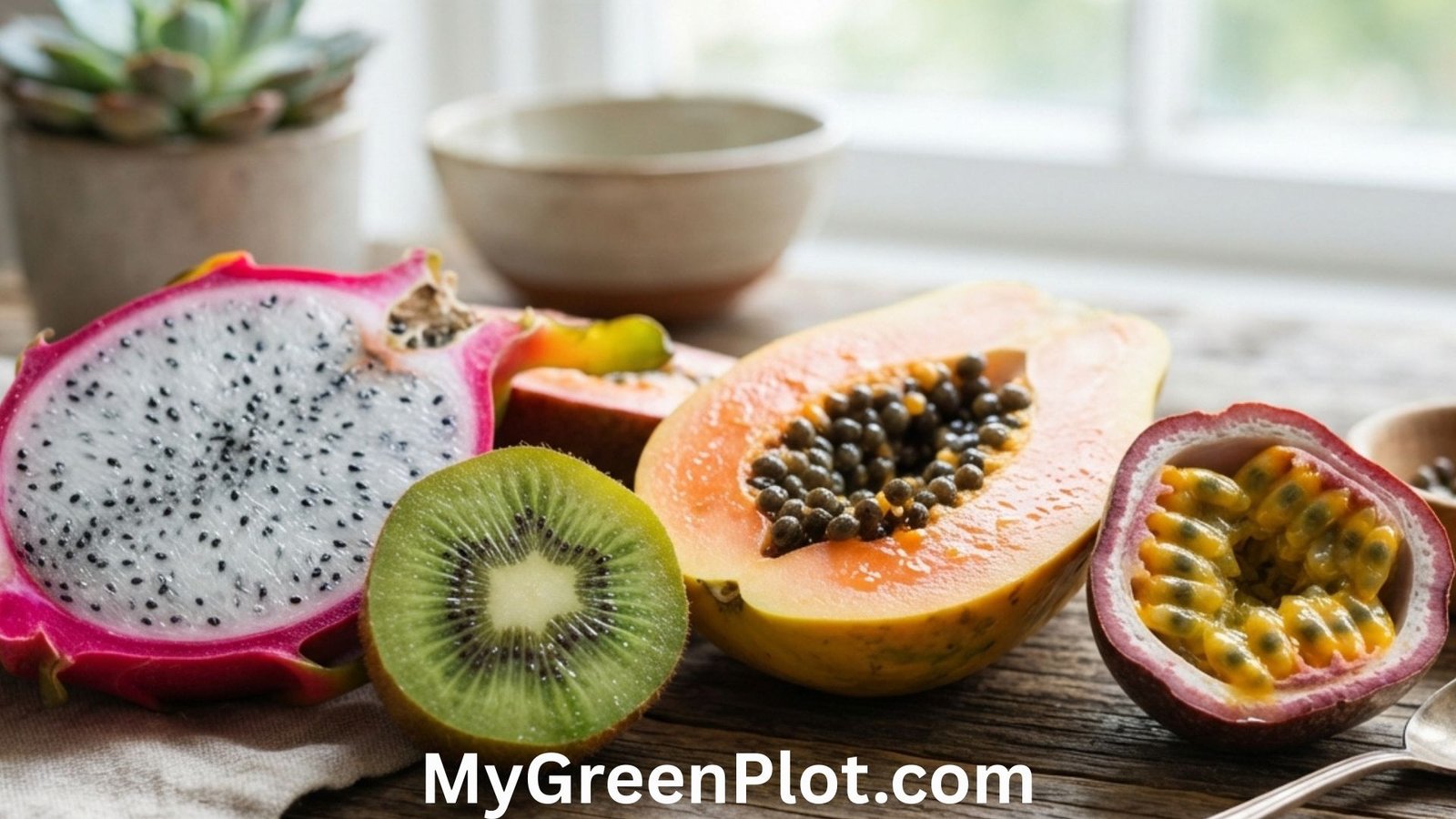
A fruit with black seeds may be dragon fruit, kiwi, passion fruit, papaya, or another seed-bearing fruit. The easiest way to identify it is to examine the flesh and the arrangement of the seeds. Dragon fruit has tiny black seeds scattered throughout its flesh, while papaya has round black seeds grouped inside a hollow central cavity.
Here are eight fruits to help you identify the one you have seen.
Dragon Fruit Has Tiny Black Seeds Scattered Throughout Its Flesh
Dragon fruit typically measures around 4–6 inches long and contains hundreds of tiny black seeds embedded in its soft flesh.
The fruit grows on a climbing cactus and has a thick outer skin that is usually pink or red, although some varieties have yellow skin. The flesh may be white, pink, or deep red, depending on the variety.
- Taste: Mildly sweet and refreshing, with a flavor often compared to kiwi or melon.
- Seeds: Tiny, black, and slightly crunchy.
- Seed edibility: The seeds are edible and normally consumed with the flesh.
- Main identifying feature: Bright skin and numerous small black dots distributed throughout the interior.
Dragon fruit grows best in warm conditions with plenty of sunlight and well-drained soil. If you grow it at home, provide a sturdy support because the heavy cactus stems need something to climb on.
Kiwi Has a Ring of Black Seeds Around Its Center
Kiwifruit generally measures about 2–3 inches long and has fuzzy brown skin, juicy flesh, and a ring of tiny black seeds around its pale center.
Green kiwifruit is usually tangy and sweet, while golden varieties tend to taste sweeter and less acidic. Both types contain edible seeds.
- Taste: Sweet with a noticeable tang, particularly in green varieties.
- Seeds: Small, oval, and black.
- Seed edibility: Yes, the seeds can be eaten with the fruit.
- Main identifying feature: Brown outer skin and a circular arrangement of black seeds inside green or golden flesh.
Kiwi differs from dragon fruit because its seeds form a more recognizable ring around the central core. The skin is also brown and fuzzy rather than covered with prominent pink bracts.
Passion Fruit Contains Black Seeds in Juicy Pulp
Passion fruit is usually round or oval, approximately 1.5–3 inches across, with a thick rind and numerous black seeds surrounded by fragrant pulp.
The purple variety often develops a wrinkled skin as it ripens. Yellow passion fruit is generally larger and can have a sharper, more acidic flavor.
- Taste: Aromatic, tangy, and sweet-acidic.
- Seeds: Small, firm, and crunchy.
- Seed edibility: The seeds and pulp are commonly eaten together.
- Main identifying feature: Jelly-like yellow-orange pulp packed with black seeds.
Passion fruit is also used in juice, desserts, sauces, and yogurt. The plant grows as a climbing vine and can reach approximately 20–30 feet under suitable conditions, so a strong trellis is useful.
Black Sapote Has Several Large, Dark Seeds
Black sapote is a tropical fruit that generally measures around 2–6 inches across. Its skin stays green even when the fruit is ripe, while its soft interior turns dark brown to nearly black.
Unlike dragon fruit and kiwi, black sapote does not have hundreds of tiny seeds scattered throughout its flesh. It may contain several large, flat seeds.
- Taste: Mildly sweet when ripe, with a soft texture often compared to chocolate pudding.
- Seeds: Large, flat, and dark brown.
- Seed edibility: Remove the seeds before eating the pulp.
- Main identifying feature: Green skin surrounding very soft, dark-colored flesh.
Black sapote must ripen fully before eating because unripe fruit can be strongly astringent. The tree also needs a warm climate and protection from frost.
Pomegranate Has Many Seeds Inside Red, Juicy Arils
Pomegranate usually measures around 3–5 inches across and contains numerous red, juicy structures called arils, each surrounding a seed.
The edible part is the juicy covering and the seed inside it. Depending on the variety, the seeds may be relatively soft or quite firm.
- Taste: Sweet-tart, with flavor varying by cultivar.
- Seeds: Located inside ruby-red arils.
- Seed edibility: The arils are commonly eaten whole, including their seeds.
- Main identifying feature: Tough outer skin and tightly packed, jewel-like red arils.
Pomegranate differs from most fruits on this list because the seeds are individually enclosed in juicy coverings. If the fruit you remember was filled with red, glistening pieces rather than soft pulp, pomegranate may be the correct identification.
Guava Contains Many Small, Hard Seeds
Guava is a round or pear-shaped tropical fruit, often measuring approximately 2–4 inches long. Its skin is commonly green or yellow, and its flesh may be white, cream-colored, or pink.
The seeds sit in the central portion of the flesh. They are usually hard and pale rather than distinctly black, so guava is a less likely match if the seeds you remember were jet-black.
- Taste: Sweet, fragrant, and sometimes slightly acidic.
- Seeds: Numerous and firm.
- Seed edibility: Commonly eaten with the fruit, although the hard texture may be unpleasant for some people.
- Main identifying feature: Strong fragrance and a dense cluster of seeds in the middle.
A ripe guava often has a distinctive aroma even before you cut it open. That smell, combined with its pale or pink flesh, can help distinguish it from other seeded tropical fruits.
Papaya Has Round Black Seeds in a Central Cavity
Papaya is an elongated tropical fruit with green skin when unripe and yellow-orange or orange flesh when ripe. Its size varies considerably by cultivar, from relatively small fruits to specimens exceeding a foot in length.
When you cut a papaya lengthwise, you will find a hollow central cavity filled with round, glossy black seeds.
- Taste: Sweet and soft when ripe, sometimes with a mild musky flavor.
- Seeds: Round, black, and concentrated in the center.
- Seed edibility: The seeds have a peppery flavor, but removing them is the simplest option for ordinary eating.
- Main identifying feature: Orange flesh surrounding a large cavity full of black seeds.
Papaya is easy to distinguish from dragon fruit because its seeds occupy one central space instead of appearing as tiny dots throughout the flesh. The seeds also have a more pronounced, peppery taste.
Black Grapes May Contain Dark Seeds
Black grapes are small, round fruits that usually measure around 0.5–1 inch across. Their skin ranges from dark purple to nearly black, and their flesh may be translucent green, purple-tinged, or reddish, depending on the variety.
Some grape varieties contain seeds, while others are bred to be seedless. The seeds of seeded grapes are generally brown or dark brown rather than completely black.
- Taste: Sweet, tart, or a combination of both.
- Seeds: Usually a few small, firm seeds per grape.
- Seed edibility: Grape seeds are commonly swallowed or chewed, although they can taste bitter.
- Main identifying feature: Small fruits growing in clusters on a woody vine.
If the fruit you remember grew in bunches and had smooth, dark-purple skin, a seeded grape may be a better match than a tropical fruit.
Can You Eat Fruits With Black Seeds?
Many familiar fruits have seeds that are commonly eaten with the flesh, but the color of a seed does not establish whether it is safe to consume.
Dragon fruit, kiwi, and passion fruit have small seeds that are normally eaten as part of the fruit. Pomegranate arils are also commonly eaten whole, including their seeds. Black sapote seeds, by contrast, should be removed before eating.
Papaya seeds are sometimes consumed, but their peppery flavor and limited evidence about regular or large-quantity consumption make them less suitable for casual snacking.
| Fruit | Seed appearance | Practical guidance |
| Dragon fruit | Tiny black dots | Eat with the flesh |
| Kiwi | Small black seeds | Eat with the flesh |
| Passion fruit | Black seeds in juicy pulp | Commonly eaten with pulp |
| Black sapote | Large, flat, dark seeds | Remove before eating |
| Pomegranate | Seeds inside red arils | Eat the arils |
| Guava | Small, hard seeds | Commonly eaten |
| Papaya | Round, glossy black seeds | Remove for ordinary eating |
| Black grapes | Small brown or dark seeds | Commonly swallowed or chewed |
Never identify an unfamiliar wild fruit by seed color alone. Some toxic fruits resemble familiar edible species, and appearance is not a reliable test of safety.
Which Fruits With Black Seeds Can You Grow at Home?
Dragon fruit and passion fruit are practical choices for warm-climate gardens, but they need different support structures and growing conditions.
Dragon fruit grows on cactus stems and benefits from a strong post or trellis. It needs well-drained soil because prolonged waterlogging can damage its roots. Passion fruit is a vigorous climbing vine that needs sunlight, room to spread, and a trellis capable of supporting its growth.
Papaya can produce fruit relatively quickly in suitable tropical conditions, but cold weather and strong winds can damage its plants. Black sapote is a larger tree that requires a warm climate and enough space for its canopy.
Growing these fruits from seed can be an enjoyable experiment, but seedlings do not always produce fruit identical to the parent plant. They may also take longer to fruit than plants propagated from cuttings or grafted material.
Sources: North Carolina State Extension | University of Florida IFAS Extension | UF/IFAS Papaya Guide | UF/IFAS Tropical Fruit Guide
Read More :
