

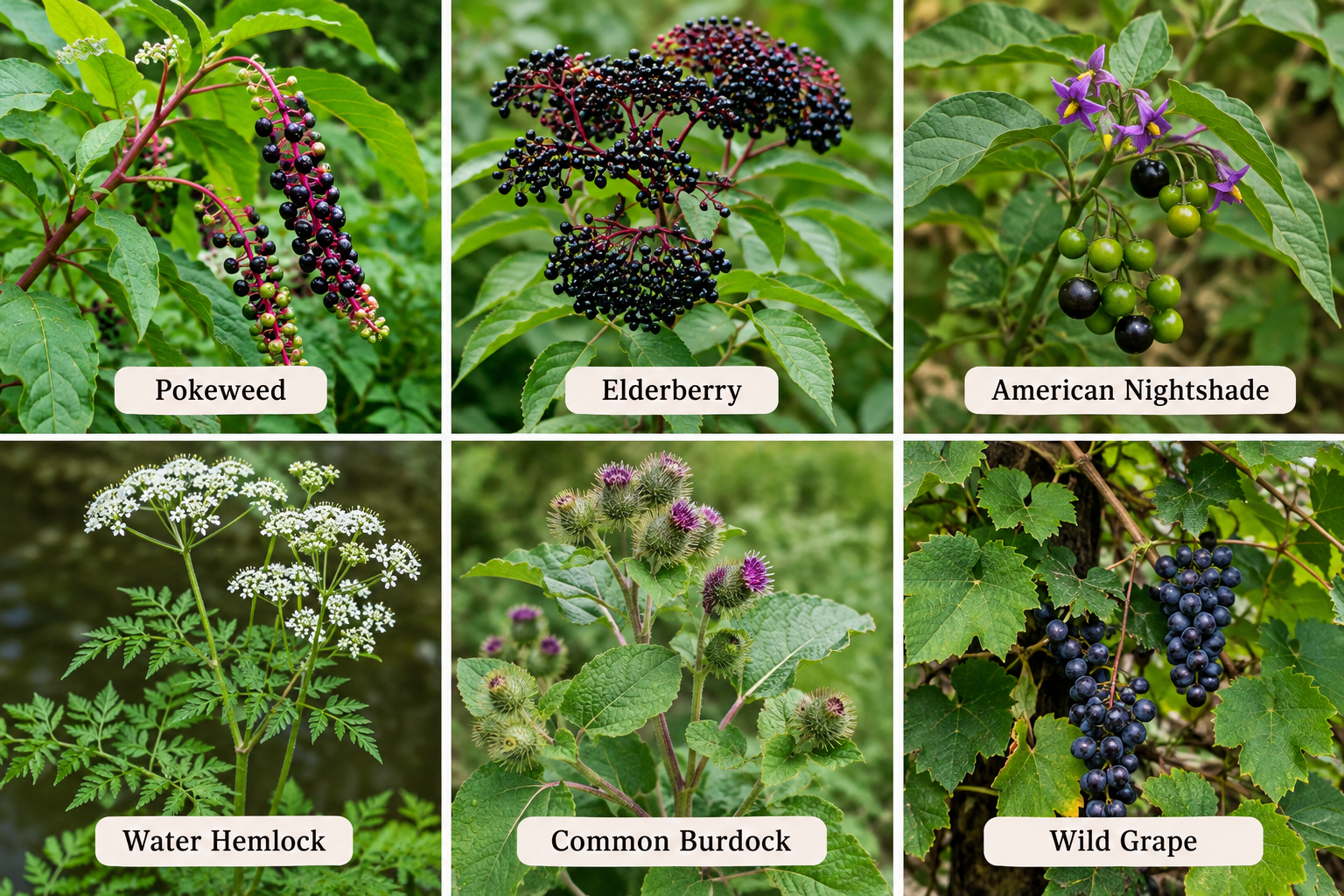
Identifying wild plants can be surprisingly difficult, especially when several species have similar leaves, stems, berries, or growth habits. Pokeweed look alikes are particularly important to recognize because pokeweed can resemble several other plants during different stages of growth.
Pokeweed (Phytolacca americana) is a large herbaceous plant commonly recognized by its reddish-purple stems, broad leaves, drooping clusters of dark berries, and vigorous growth. However, leaf shape and berry color can vary with age and growing conditions, making identification more challenging.
Knowing the characteristics that separate pokeweed from similar plants can help prevent mistaken identification. This guide examines several common plants that may be confused with pokeweed and explains the key features to look for.
What Does Pokeweed Look Like?
Before learning about Pokeweed Look Alikes, it helps to understand the basic appearance of pokeweed.
Pokeweed is a perennial plant that can grow several feet tall. Young plants generally have soft green stems, while mature stems often become reddish, purplish, or magenta. Its leaves are relatively large, smooth, and oval to lance-shaped, with pointed tips.
The plant produces elongated clusters of small flowers during the growing season. These flowers are followed by berries that mature from green to deep purple or nearly black. The berry clusters often hang downward from the stems.
Another useful characteristic is the plant’s substantial root system. Mature pokeweed can return year after year from its perennial roots, even when the above-ground growth dies back during winter.
Because individual characteristics can overlap with other plants, identification should rely on several features rather than a single leaf or berry.
Pokeweed vs. Elderberry
Elderberry is one of the plants that can cause confusion when people encounter dark berries in the wild. Species of elder (Sambucus) can produce clusters of berries that look superficially similar to mature pokeweed fruit.
The growth pattern, however, is different. Pokeweed berries typically occur on elongated, drooping clusters attached directly to herbaceous stems. Elderberries generally occur in broader, branched clusters.
Elder plants are also woody shrubs or small trees rather than the large herbaceous plants characteristic of pokeweed. Their leaves are compound, meaning multiple leaflets are arranged along a central leaf stalk.
By contrast, pokeweed has simple leaves, with each leaf consisting of a single broad blade.
When distinguishing these plants, examine the entire plant rather than focusing only on the berries. The difference between simple pokeweed leaves and compound elder leaves is particularly useful.
Pokeweed vs. American Nightshade
Some nightshade species can also be mistaken for pokeweed, particularly when young plants or berries are involved.
American black nightshade (Solanum americanum) is generally much smaller than mature pokeweed. It has relatively small leaves and produces small berries, often in compact clusters. Pokeweed usually develops much larger leaves and can become considerably taller.
The flowers provide another useful clue. Nightshade plants typically produce small, star-shaped flowers, while pokeweed develops clusters of tiny flowers on elongated stalks.
Berry arrangement and plant size should therefore be considered together. A plant with small berries and comparatively small leaves may belong to a nightshade species rather than pokeweed.
Because nightshade species can vary considerably, berry appearance alone should not be used as the deciding characteristic.
Pokeweed vs. Water Hemlock
Water hemlock is another plant that deserves careful attention because some of its features can overlap with other large wild plants.
Water hemlock belongs to the carrot family and has finely divided, compound leaves. Its foliage therefore looks substantially different from pokeweed’s broad, simple leaves when the two plants are examined closely.
Water hemlock commonly grows in wet environments, including areas near streams, wetlands, and damp meadows. Pokeweed can also grow in moist locations but is not restricted to them.
This distinction is especially important because water hemlock is highly poisonous. Never consume a wild plant simply because it appears to match a familiar species.
When identification is uncertain, avoid tasting, eating, or handling plant material unnecessarily and seek confirmation from a qualified botanist, extension service, or reliable regional plant-identification resource.
Pokeweed vs. Common Burdock
Young burdock can sometimes create confusion because its leaves can become large and broad.
Burdock (Arctium species) generally produces very large leaves, often with a noticeably different texture and arrangement from pokeweed. Its leaves may appear more heart-shaped or broadly oval, depending on the species and stage of growth.
One of the clearest differences becomes apparent when the plants mature. Burdock produces distinctive burr-like flower heads that eventually develop hooked structures capable of attaching to clothing or animal fur.
Pokeweed instead produces hanging clusters of berries after flowering.
The stems and overall growth structure can also help distinguish the plants. Looking at the plant’s complete form, including its flowers or fruit, is much more reliable than comparing one large leaf.
Pokeweed vs. Wild Grape
Wild grape vines can sometimes be confused with other berry-producing plants because their fruit may become dark purple or black when ripe.
The most important difference is growth habit. Wild grapes are woody climbing or trailing vines, whereas pokeweed is an upright herbaceous plant.
Wild grape leaves are also distinctive. They are generally lobed or toothed and grow on vines that may climb nearby vegetation. Pokeweed leaves are not deeply lobed and are arranged along upright stems.
Grape clusters usually have a different structure as well. The berries develop in clusters associated with a vine rather than on the characteristic elongated, drooping fruit stalks of pokeweed.
If a dark-berried plant is clearly climbing or producing tendrils, it is worth considering a grape or another vine rather than pokeweed.
Key Features for Identifying Pokeweed Look Alikes
When examining Pokeweed Look Alikes, avoid relying on berry color alone. A systematic identification process is much safer and more accurate.
Consider these features:
- Stem: Mature pokeweed often has reddish, purple, or magenta stems.
- Leaves: Pokeweed has large, simple, generally smooth-edged leaves.
- Growth habit: It is an upright herbaceous plant rather than a woody shrub or climbing vine.
- Flowers: Small flowers develop in elongated clusters.
- Fruit: Mature berries are dark purple to nearly black and commonly occur on drooping clusters.
- Plant size: Mature pokeweed can become a large plant compared with many berry-producing weeds.
- Season: The plant changes considerably as it develops, so identification should account for its growth stage.
- Location: Habitat can provide supporting information, although it should never be the only identification feature.
Photographing the entire plant, its stem, leaves, flowers, and fruit can make identification easier. If possible, compare several characteristics with a reputable botanical reference rather than matching a single photograph.
Safety When Identifying Pokeweed and Similar Plants
Correct identification is particularly important with wild plants because some visually similar species can be poisonous. Pokeweed itself contains toxic compounds, with different plant parts varying in toxicity and the concentration changing as the plant develops.
Do not assume that cooking, processing, or removing one part automatically makes an uncertain wild plant safe to eat. Traditional food practices involving properly prepared young pokeweed should not be treated as a general recommendation for consuming unidentified plants.
Children and pets should also be kept away from unknown berries and plant material.
If someone has eaten an unidentified wild plant and develops concerning symptoms, contact an appropriate poison-control service or seek urgent medical assistance. Do not induce vomiting unless instructed by a medical professional or poison-control specialist.
The safest approach to Pokeweed Look Alikes is simple: identify the plant confidently before considering any use, and when identification remains uncertain, leave the plant alone.
Frequently Asked Questions
1. What are the most common pokeweed look alikes?
Plants that may be confused with pokeweed include elderberry, certain nightshade species, burdock, wild grape, and other plants with large leaves or dark berries. Their leaf structure, stem, growth habit, flower arrangement, and fruit clusters can help distinguish them.
2. How can I tell pokeweed from elderberry?
The leaves are one of the easiest clues. Pokeweed has simple leaves, while elderberry has compound leaves made up of multiple leaflets. Pokeweed is also an herbaceous plant, whereas elderberry is a woody shrub.
3. Are pokeweed berries poisonous?
Pokeweed berries contain toxic compounds, and the plant should not be considered safe to eat simply based on appearance or traditional references. Children and pets should not be allowed to consume the berries or other parts of an unidentified plant.
4. Can pokeweed be confused with wild grapes?
Yes. Both can produce dark berries, but wild grapes are woody vines, while pokeweed is an upright herbaceous plant. Wild grape leaves are also typically lobed or toothed, providing another useful distinction.
5. What should I do if I cannot identify a pokeweed look alike?
Do not eat or taste it. Take clear photographs of the entire plant, including its leaves, stem, flowers, and fruit, and consult a qualified botanist, local extension service, or dependable regional plant-identification guide.
Conclusion
Learning to recognize Pokeweed Look Alikes requires more than comparing berry colors. The plant’s leaves, stems, growth habit, flowers, fruit clusters, size, and habitat all provide useful identification clues.
Elderberry, nightshade, burdock, water hemlock, and wild grape can have features that cause confusion, but careful observation can reveal important differences. Because some wild plants are poisonous, uncertain identification should always be treated cautiously.
When in doubt, avoid consuming the plant and seek expert identification. A careful, whole-plant approach is the best way to distinguish pokeweed from similar species while keeping plant identification safe and accurate.
