

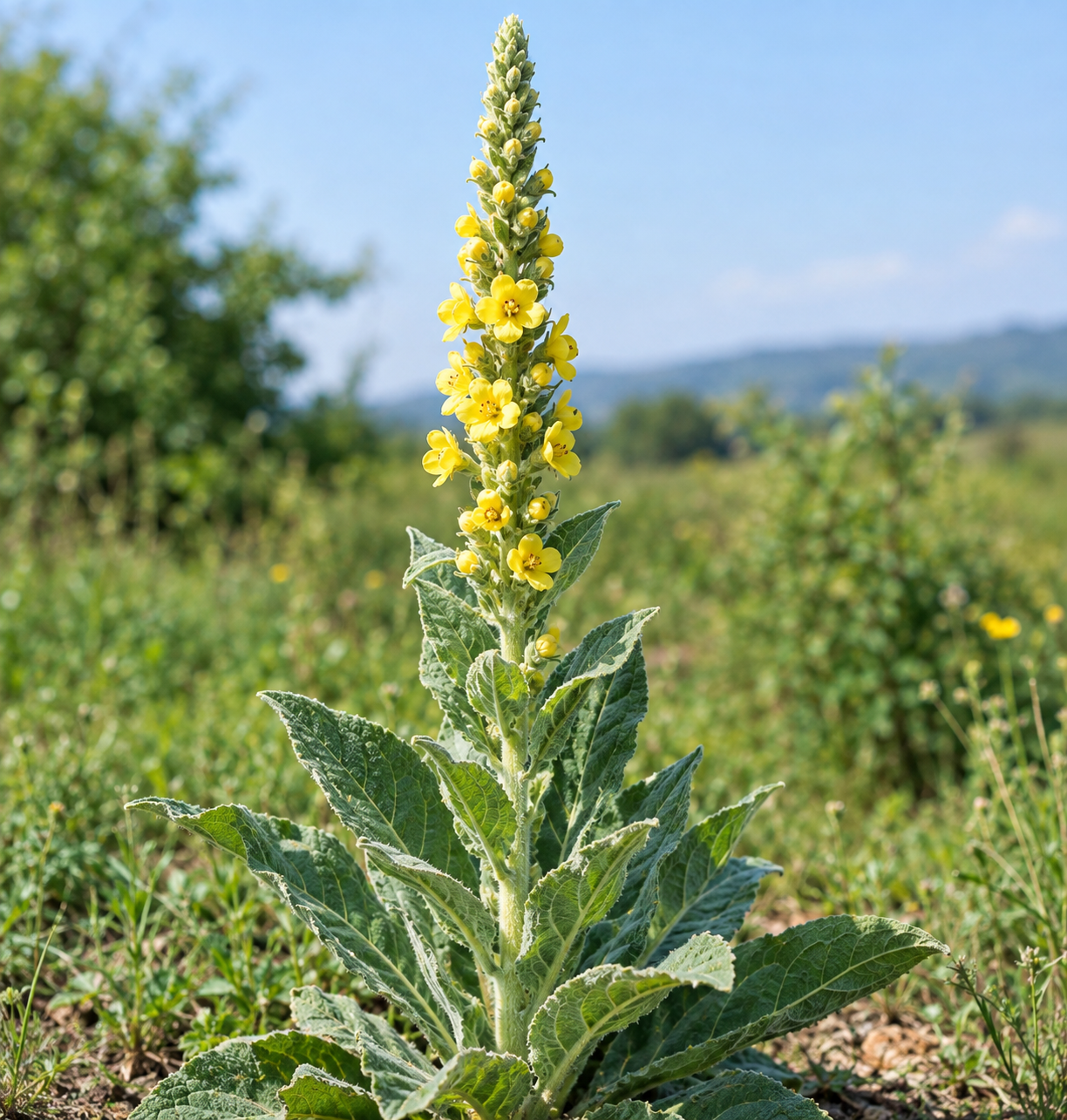
Mullein is a distinctive-looking plant, but several wild plants can resemble it, especially during the early stages of growth. Learning about mullein look alikes is useful for gardeners, hikers, foragers, and anyone interested in identifying plants accurately.
Common mullein (Verbascum thapsus) is best known for its large, fuzzy leaves and tall flowering stalk. However, leaf shape, hairiness, and rosette growth can vary depending on the plant’s age and growing conditions. Several species may therefore appear similar at first glance.
This guide explains the main characteristics of mullein and discusses plants that can be confused with it, along with practical features that help distinguish them.
What Does Mullein Look Like?
Before comparing mullein look alikes, it helps to understand the typical appearance of common mullein.
Common mullein is a biennial plant. During its first year, it generally forms a large basal rosette of soft, gray-green leaves. These leaves are covered with fine hairs, giving them a noticeably fuzzy or woolly texture.
During the second year, the plant develops a tall, upright flowering stalk that can reach several feet in height. Yellow flowers appear along the upper portion of the stalk, creating the familiar tall, candle-like appearance associated with mullein.
The leaves are usually broad near the base and become smaller farther up the flowering stem. The combination of a woolly surface, basal rosette, and tall flowering stalk provides several useful identification clues.
Lamb’s Ear as a Mullein Look Alike
Lamb’s ear (Stachys byzantina) is one plant that can resemble young mullein because both have soft, fuzzy leaves.
The main similarity is their dense covering of fine hairs. Both plants can appear grayish or silvery from a distance, particularly when growing in sunny locations.
However, lamb’s ear generally has smaller leaves with a softer, more rounded appearance. It is also commonly grown as an ornamental garden plant and tends to form spreading clumps rather than developing the very tall flowering stalk characteristic of mature common mullein.
Mullein leaves are generally larger and more elongated, especially as the basal rosette develops.
If a plant has thick, velvety leaves but remains relatively low and forms a spreading garden-like clump, lamb’s ear may be a better match than mullein.
Foxglove and Mullein: Important Differences
Foxglove (Digitalis species) can sometimes be confused with mullein because both plants can produce tall flowering stalks and large leaves.
The flowers provide an important distinction. Mullein commonly produces small yellow flowers arranged along an upright spike, while foxglove is recognized for larger, tubular or bell-shaped flowers that hang from the flowering stalk.
Foxglove leaves can also have a different texture and margin from common mullein. Depending on the species, foxglove foliage may be hairy but is generally not as distinctly woolly as mullein.
This distinction is particularly important because some foxglove species contain potent cardiac compounds and should not be consumed.
When identifying an unfamiliar tall plant, examine the flowers rather than relying solely on the height or leaf size.
Comfrey and Other Broad-Leaved Plants
Comfrey (Symphytum species) is another plant that can create confusion, particularly when only its foliage is visible.
Young comfrey plants can have large, hairy leaves that superficially resemble the foliage of mullein. Both plants can also occur in open areas and disturbed habitats.
A closer examination reveals differences in leaf arrangement, shape, and overall growth pattern. Comfrey leaves are often more strongly veined and may extend downward along the stem, depending on the species. Mullein’s large basal leaves form a more recognizable rosette during its first year.
Flowers are another useful identifying feature. Comfrey generally produces tubular, bell-like flowers that can occur in colors such as purple, pink, cream, or yellow, while common mullein has characteristic yellow flowers.
Because plant appearance changes with age, examining several characteristics is more reliable than identifying a species from one leaf.
Burdock and Mullein Rosettes
Burdock (Arctium species) can resemble young mullein because both can produce large basal leaves.
The leaves of burdock are generally broad and may have a more pronounced heart-shaped appearance. Their surfaces can vary from relatively smooth to somewhat hairy, depending on the species and maturity.
Mullein leaves are typically covered in dense fine hairs, giving them a distinctly velvety or woolly feel and appearance.
Burdock also develops recognizable flower heads later in its growth cycle. Its mature flower heads become burrs with hooked structures, while mullein produces yellow flowers along a tall spike.
Looking at the leaf texture is therefore helpful, but the plant’s complete growth pattern and later flowering structure provide stronger evidence.
How to Distinguish Mullein From Similar Plants
When identifying mullein look alikes, use multiple characteristics rather than depending on one visual feature.
Important clues include:
- Leaf texture: Common mullein has noticeably woolly or velvety leaves.
- Leaf arrangement: First-year plants typically form a large basal rosette.
- Leaf shape: Leaves are generally elongated and become smaller toward the flowering stalk.
- Flower color: Common mullein produces yellow flowers.
- Flowering structure: Flowers are arranged along a tall, upright spike.
- Plant height: Mature plants can become quite tall.
- Stem: The flowering stem is upright and relatively prominent.
- Growth cycle: Common mullein is generally biennial, forming a rosette before flowering.
Photographing the entire plant can make identification easier. Close-up photographs of the leaf surface, leaf margins, stem, flowers, and overall growth habit are particularly useful when comparing a plant with a field guide.
Why Correct Identification Matters
Correctly identifying mullein look alikes is important because plants with similar leaves or flowers may have very different properties.
A plant should never be consumed simply because it resembles mullein. Visual similarity does not establish botanical identity or safety.
This is especially important when dealing with plants such as foxglove, which can resemble other tall, leafy plants but contains powerful naturally occurring compounds.
Identification should also take regional variation into account. Different species and varieties can look somewhat different depending on their location, climate, soil, and stage of growth.
For uncertain specimens, use a reputable botanical reference or consult a qualified botanist, herbarium, agricultural extension service, or experienced local plant specialist.
Practical Tips for Identifying Mullein
Identifying mullein becomes easier when you examine the plant systematically.
Start with the overall growth habit. A young common mullein generally appears as a large, low-growing rosette. If the plant is mature, look for a tall flowering stalk.
Next, examine the leaves. The soft, densely hairy surface is one of the most recognizable characteristics of common mullein. Compare the leaf shape and arrangement with reliable botanical photographs or descriptions.
Finally, examine the flowers and stem. Mature common mullein typically has a tall spike bearing yellow flowers.
Avoid identifying a plant solely from a photograph of a single leaf. Similar species can share individual characteristics, while the combination of several traits is much more informative.
If identification remains uncertain, do not consume or use the plant. Leave it undisturbed and seek expert confirmation.
Frequently Asked Questions
1. What are the most common mullein look alikes?
Common plants that may be confused with mullein include lamb’s ear, foxglove, comfrey, and burdock. The best way to distinguish them is to compare leaf texture, leaf arrangement, flower structure, color, and overall growth habit.
2. How can I tell mullein from lamb’s ear?
Both plants have fuzzy leaves, but common mullein usually develops a much larger basal rosette and eventually produces a tall flowering stalk. Lamb’s ear generally has smaller, thicker, rounded leaves and forms low-growing clumps.
3. Does mullein have yellow flowers?
Yes. Common mullein typically produces small yellow flowers along an upright flowering spike. Flower color and arrangement can help distinguish it from several similar plants.
4. Can foxglove be mistaken for mullein?
Yes, especially when identifying a tall plant from a distance. However, foxglove has prominent tubular or bell-shaped flowers, while common mullein produces smaller yellow flowers along a tall spike. Because foxglove can be poisonous, uncertain plants should not be consumed.
5. What is the easiest way to identify mullein?
Look for the combination of a large, woolly basal rosette, densely hairy leaves, and, in mature plants, a tall upright flowering stalk with yellow flowers. Using several characteristics together is more reliable than relying on one feature.
Conclusion
Understanding mullein look alikes makes wild-plant identification more accurate and helps prevent confusion between visually similar species. Common mullein is characterized by its woolly leaves, basal rosette, tall flowering stalk, and yellow flowers.
Lamb’s ear, foxglove, comfrey, and burdock can share some characteristics with mullein, but differences in leaf structure, texture, flowers, and growth habit can help separate them.
When identifying an unfamiliar plant, examine the entire specimen and compare multiple characteristics with a reliable botanical reference. If you cannot confidently establish its identity, avoid consuming or using it and seek expert assistance.

1 Comment
Pingback: Goldenrod Look Alikes: A Complete Guide to Similar Yellow Wildflowers - mygreenplot.com