

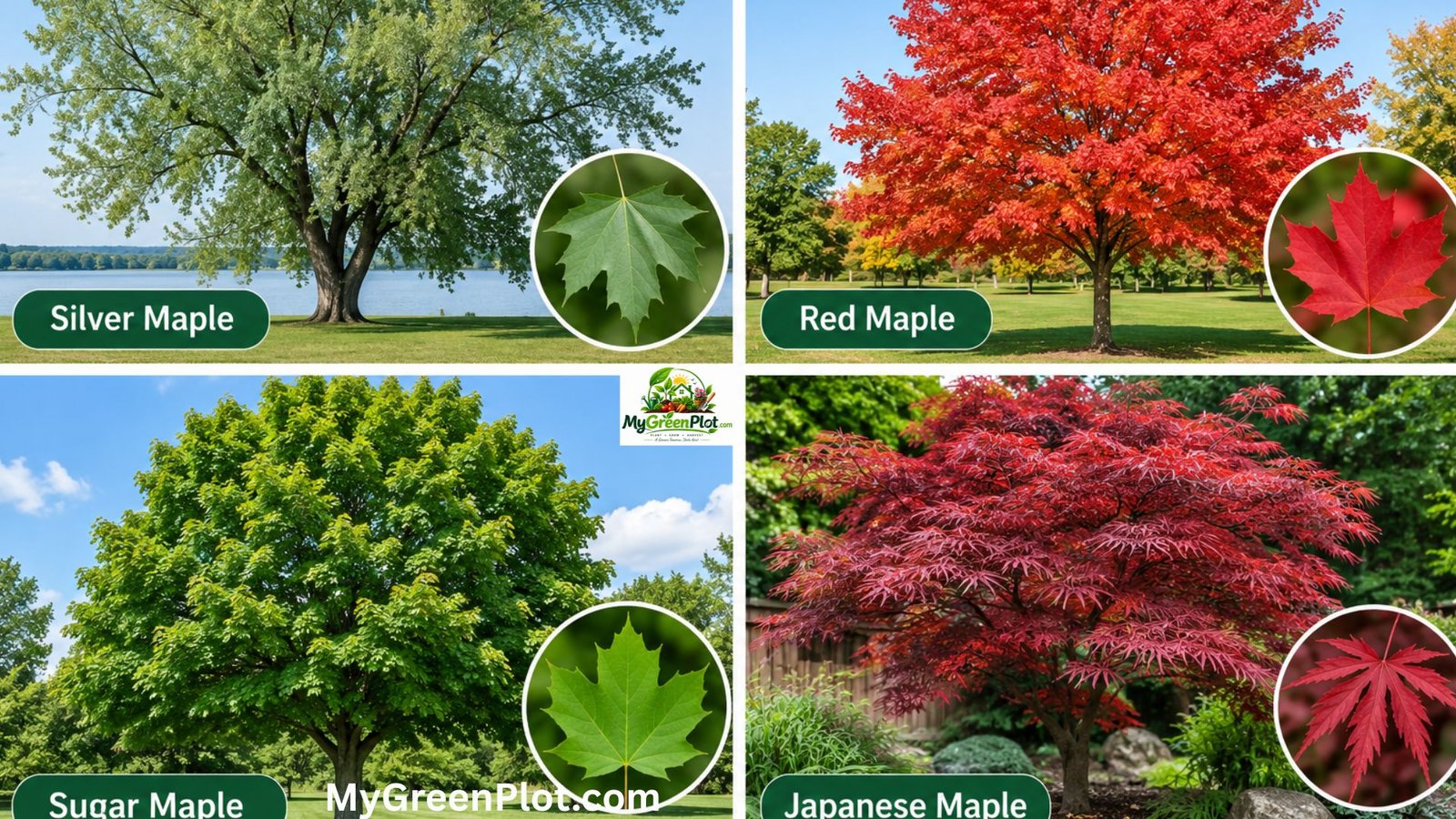
Maple trees are among the most recognizable trees in gardens, forests, parks, and residential landscapes. They are admired for their attractive foliage, distinctive leaves, graceful shapes, and brilliant autumn colors. With many species and cultivars available, understanding the different types of maple trees can help you choose the right variety for your landscape.
Maples belong to the genus Acer, which includes trees ranging from compact ornamental varieties to large forest trees. Some are especially valued for their fall foliage, while others are popular for shade, attractive bark, or maple syrup production.
What Are Maple Trees?
Maple trees are deciduous or evergreen trees and shrubs belonging to the Acer genus. Most commonly grown maples are deciduous, meaning they lose their leaves during the colder months. Their leaves are often lobed and can turn spectacular shades of yellow, orange, red, or purple in autumn.
Maples vary considerably in size and appearance. Some species can become large shade trees, while others remain relatively small and are suitable for gardens with limited space.
Different maple species also have different growing requirements. Factors such as soil type, sunlight, moisture, climate, and available space should therefore be considered before planting one.
Japanese Maple
The Japanese maple (Acer palmatum) is one of the most popular ornamental maples. It is generally smaller than many North American maple species and is widely planted in gardens, courtyards, and landscaped areas.
Japanese maples are available in numerous forms, including upright trees, spreading varieties, and delicate weeping types. Their leaves may be green, red, burgundy, or purple depending on the cultivar and season.
They are especially valued for their fine foliage and attractive autumn color. Many Japanese maples perform well in locations with morning sun and some afternoon protection, particularly in warmer climates.
Sugar Maple
The sugar maple (Acer saccharum) is a large, long-lived tree best known for its brilliant fall foliage and its role in maple syrup production.
Its leaves typically have five lobes and can turn vibrant shades of yellow, orange, and red in autumn. Sugar maples can develop broad, rounded crowns, making them excellent shade trees where sufficient space is available.
They generally prefer well-drained, fertile soil and climates with cold winters and moderate summers. Because they can grow quite large, sugar maples are better suited to spacious landscapes than small yards.
Red Maple
The red maple (Acer rubrum) is one of the most widely distributed maple species in North America. It gets its common name from the reddish color that appears in several parts of the tree, including its flowers, leaf stems, and autumn foliage.
Red maple leaves can turn brilliant red, orange, or yellow in fall. The species is adaptable to a variety of soil conditions and is commonly used as a shade and ornamental tree.
Red maples can grow relatively quickly under suitable conditions. Their mature size makes it important to provide enough room for the roots, branches, and crown to develop properly.
Silver Maple
The silver maple (Acer saccharinum) is a fast-growing tree known for its distinctive leaves. The upper surfaces of the leaves are green, while the undersides are silvery-white, creating an attractive effect when the leaves move in the wind.
Silver maples can provide substantial shade and are often associated with moist environments. However, their rapid growth can result in relatively weak branches compared with some slower-growing maple species.
Because of their size and branch structure, silver maples should be planted carefully, particularly near buildings, driveways, and other structures.
Other Popular Maple Varieties
Beyond the well-known species, several other maple varieties are important in landscaping and natural environments.
Norway maple (Acer platanoides): This large maple has dense foliage and a rounded crown. It has historically been planted as a shade tree in many areas.
Amur maple (Acer ginnala): A smaller maple that is often grown as a multi-stemmed tree or large shrub. It can develop attractive red autumn foliage and is suitable for more compact landscapes.
Paperbark maple (Acer griseum): This slow-growing ornamental tree is particularly valued for its cinnamon-colored, peeling bark. It can provide visual interest even after its leaves have fallen.
Boxelder (Acer negundo): Unlike many maples, boxelder usually has compound leaves. It is a hardy species that can tolerate a range of growing conditions.
These varieties demonstrate how diverse maple trees can be in terms of size, foliage, bark, and landscape use.
How to Choose the Right Maple Tree
Choosing among the different types of maple trees depends on the conditions of your property and the characteristics you want from the tree.
First, consider the mature size. Large species such as sugar maple and red maple require considerable space, while smaller ornamental varieties such as Japanese maple can work better in gardens and smaller landscapes.
Sunlight is another important consideration. Some maples tolerate full sun well, while certain ornamental cultivars benefit from protection from intense afternoon heat.
Soil and moisture requirements should also be considered. Some species prefer consistently moist soil, while others are more adaptable. Good drainage is important for many maple varieties.
Finally, think about the tree’s main purpose. If you want brilliant fall color, an ornamental feature, shade, distinctive bark, or a tree associated with maple syrup production, different species may be appropriate.
Caring for Maple Trees
Proper care helps maple trees establish healthy roots and maintain attractive growth. Newly planted trees generally benefit from regular watering, particularly during dry periods.
Applying a layer of organic mulch around the root zone can help conserve soil moisture and moderate soil temperature. Keep mulch away from direct contact with the trunk to reduce the risk of moisture-related problems.
Pruning should generally focus on removing dead, damaged, or poorly positioned branches. Excessive pruning can negatively affect the tree’s natural shape.
It is also useful to monitor maple trees for signs of stress, pests, disease, or drought damage. Providing appropriate growing conditions from the beginning is one of the most effective ways to support long-term tree health.
Frequently Asked Questions
1. What is the most common type of maple tree?
There is no single maple species that is universally the most common. Red maple, sugar maple, silver maple, and Japanese maple are among the widely recognized species, although their popularity varies by region and purpose.
2. Which maple tree has the best fall color?
Fall color depends on the species, cultivar, climate, and growing conditions. Red maple and Japanese maple are particularly valued for their attractive autumn colors, while sugar maple can also produce spectacular displays.
3. Which maple tree is best for a small garden?
Japanese maple is often a suitable choice for smaller gardens because many cultivars remain relatively compact. However, mature size varies considerably between cultivars, so the specific variety should be checked before planting.
4. Do all maple trees produce maple syrup?
No. Although many maple species contain sap with sugars, sugar maple is the species most closely associated with commercial maple syrup production. Other species may also be tapped, but their sap can differ in sugar content and flavor.
5. How fast do maple trees grow?
Growth rates vary significantly among species and growing conditions. Some, such as silver maple, can grow relatively quickly, while ornamental species such as paperbark maple generally grow much more slowly.
Conclusion
The many types of maple trees offer a wide range of choices for gardens, parks, and larger landscapes. Japanese maple is appreciated for its ornamental foliage, sugar maple for its fall color and syrup production, red maple for its adaptability and autumn display, and silver maple for its rapid growth and shade.
Before choosing a maple, consider its mature size, foliage, climate requirements, soil conditions, and intended purpose. Selecting a species that matches your landscape can help you enjoy the distinctive beauty of maple trees for many years.
