

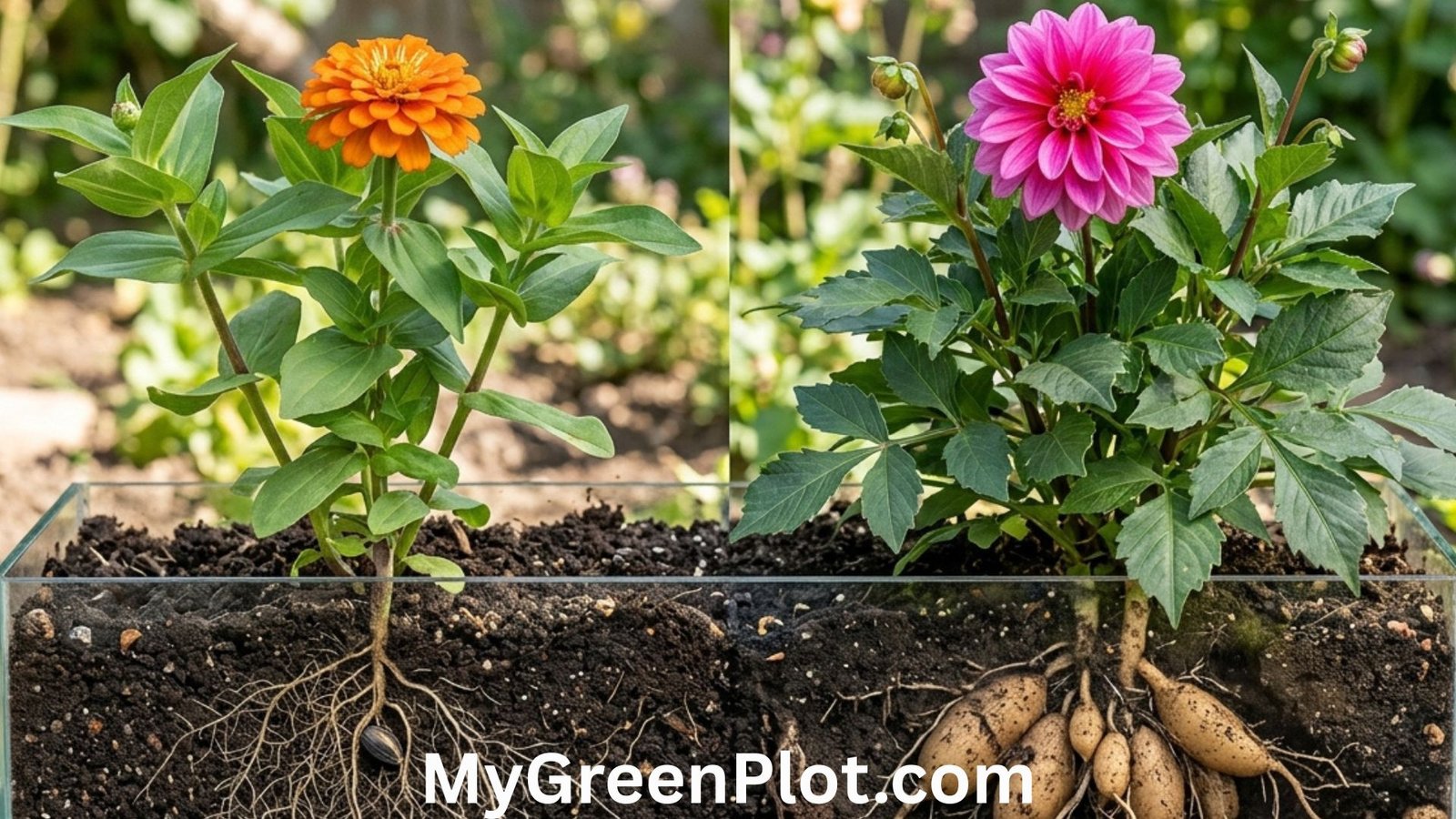
Zinnias and dahlias can produce similarly shaped, colorful flowers, but the biggest difference is how you grow them: most garden zinnias start from seeds and complete their life cycle in one season, while dahlias grow from underground tubers that can produce new shoots year after year in suitable conditions. Both belong to the daisy family, yet their leaves, root systems, maintenance needs, and flower varieties make them useful for different garden designs.
What Makes Zinnias and Dahlias Different?
Zinnias are generally simpler to grow from seed, whereas dahlias offer a wide selection of flower forms, including decorative, cactus, ball, and dinner-plate types.
The easiest way to tell them apart is to examine the foliage. A common garden zinnia has broad, simple leaves arranged opposite each other on the stem. Many dahlias have divided leaves with several leaflets, giving their foliage a more textured appearance.
Flower shape alone can be misleading. A double zinnia may resemble a dahlia so closely that you cannot reliably identify it from a photograph of the bloom alone. Some seed catalogs even describe zinnia varieties as “dahlia-flowered,” referring to the shape of their blooms rather than their botanical identity.
| Feature | Zinnia | Dahlia |
|---|---|---|
| Botanical name | Zinnia spp. | Dahlia spp. |
| Typical life cycle | Annual | Tuberous perennial |
| Common starting method | Seeds | Tubers |
| Leaf appearance | Broad, simple leaves | Often divided leaves |
| Flower styles | Single, semi-double, double | Decorative, cactus, pompon, ball, and more |
| Typical height | About 6 inches to 4 feet | Roughly 1–6 feet, depending on variety |
| Seasonal care | Usually replanted annually | Tubers may be saved for another season |
These height ranges are approximate. The seed packet or tuber label is more useful than the plant name alone when planning a garden bed.
How Much Sunlight and Water Do These Flowers Need?
Zinnias and dahlias generally need at least six hours of direct sunlight daily, with many varieties performing best in eight hours or more. Both prefer well-drained soil because waterlogged roots can lead to poor growth and disease.
Zinnias handle warm summer weather well and can flower for months when regularly harvested or deadheaded. Dahlias also enjoy sunshine, but large-flowered varieties may need more consistent watering and support as their stems grow heavy with blooms.
For a healthy planting:
- Sunlight: Choose an open location that receives at least six hours of direct sun.
- Soil: Improve heavy soil with suitable organic matter and make sure excess water can drain away.
- Watering: Water deeply when the soil begins to dry rather than giving both plants frequent, shallow splashes.
- Spacing: Small zinnias may need around 8–12 inches between plants, while larger varieties and dahlias often require more room.
- Airflow: Avoid crowding foliage together, particularly in humid weather.
The exact spacing depends on mature plant width. A compact zinnia may fit comfortably in a narrow border, while a tall dahlia can occupy much of the space intended for a neighboring plant.
Read More : Carnation vs Marigold
Can I Grow Zinnias and Dahlias Together?
Yes, zinnias and dahlias can share a flower bed because their sunlight and drainage requirements are similar. The trick is to arrange them according to mature height and spread so that larger plants do not shade smaller ones.
Put tall dahlias toward the back of a border and shorter zinnias toward the front. If you are planting in a circular bed viewed from every side, place the tallest varieties near the center instead.
Leave enough room for air to move between mature plants. Depending on the cultivar, zinnias may need 8–24 inches of spacing, while dahlias may need approximately 12–36 inches. Always check the recommended spacing for the particular variety you are growing.
You can also use both flowers in a cutting garden. Zinnias provide an easy supply of stems from seed-grown plants, while dahlias add larger blooms and a wider selection of shapes. Harvesting flowers regularly can help keep the planting productive, although the flowering response differs between cultivars.
Why Are Zinnias Sometimes Called Dirty Flowers?
The phrase “dirty flower” is an informal description rather than a botanical classification. In floral arranging, zinnias may be considered messy when their stems or leaves deteriorate in vase water, making the arrangement harder to maintain.
This does not mean that every zinnia produces dirty water or that the plant is inherently unclean. Vase conditions, foliage left underwater, and the condition of freshly cut stems all influence how quickly water becomes cloudy.
To keep cut zinnias fresh, remove leaves below the waterline, use a clean vase, trim the stems with a clean tool, and replace the water regularly.
Garden-grown zinnias can also develop powdery mildew, which appears as a pale, powder-like coating on leaves. That is a plant disease, not the reason the informal floral-arranging term is used. Good airflow, sensible spacing, and varieties with improved disease resistance can help reduce this problem.
Are Zinnias Similar to Dahlias?
Zinnias and dahlias are similar in that both belong to the Asteraceae family and produce flower heads made up of many small individual florets. Some varieties of each plant have tightly packed petals that create a rounded, decorative appearance.
Their resemblance is especially noticeable in double-flowered varieties. A large, densely petaled zinnia can look like a small decorative dahlia, and the two flowers are often used together in summer bouquets.
However, their resemblance does not make them the same plant. A zinnia grows from a seed into a new annual plant, while a dahlia develops from a tuber with growing points that can produce new shoots. Looking at the leaves and considering how the plant was started are more reliable identification clues than flower color.
Which Flower Is Better for Containers and Small Gardens?
Zinnias are often the easier option for beginners who want inexpensive summer flowers, while dahlias are worth considering when you want particular bloom shapes or larger statement flowers.
For containers, choose compact zinnia varieties and use a pot with drainage holes. Taller zinnias can grow in containers too, but they need enough root space and may require support in windy locations.
Dahlias can also grow in pots, provided the container is large enough for the chosen variety and its tuber. A small pot can restrict growth and dry out quickly during hot weather, so match the container size to the mature plant rather than choosing a pot based only on the tuber.
If you want flowers from seed without storing plant material over winter, zinnias are a practical choice. If you prefer to save tubers and grow the same dahlia variety again, dahlias offer that possibility in climates where the tubers can be protected from freezing conditions.
When Should You Plant Zinnias and Dahlias?
Plant zinnias outdoors after frost danger has passed and the soil has warmed. For reliable germination, a soil temperature around 70°F (21°C) is a useful target, and seeds commonly emerge in about 5–10 days under favorable conditions.
Dahlia tubers should be planted after the soil has warmed and the risk of damaging frost has passed. A soil temperature near 60°F (16°C) is a reasonable guide for planting, but wet, cold soil can encourage tuber rot.
In warm climates, planting dates may be earlier than in cooler regions. In places with extremely hot summers, avoid allowing newly planted tubers or seedlings to dry out during establishment.
Zinnias commonly begin flowering about 8–12 weeks after sowing, depending on the variety and growing conditions. Dahlias vary more widely, so use the cultivar information to estimate when the first flowers are likely to appear.
