

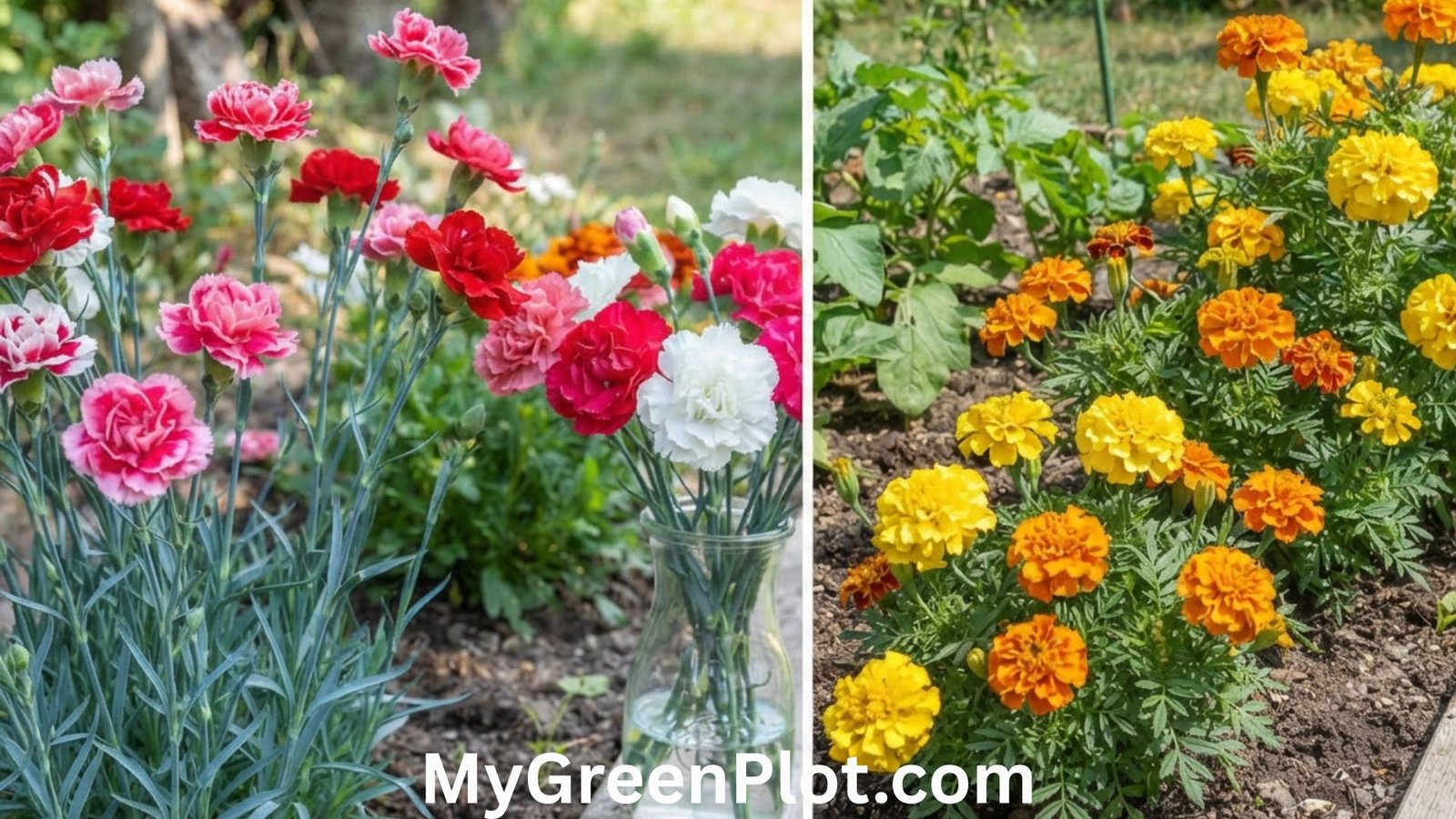
Carnations and marigolds are both popular garden flowers, but they serve different purposes. Carnations (Dianthus caryophyllus) are known for their ruffled petals, slender stems, and use in bouquets, while marigolds (Tagetes species) produce rounded yellow, orange, or gold flowers that are especially useful in sunny garden beds. Both generally benefit from around 6 hours of direct sunlight daily, although their performance depends on the variety, temperature, and growing conditions.
How Do Carnations and Marigolds Look Different?
Carnations usually have frilled petals arranged around a central flower, whereas marigolds commonly produce compact, rounded flower heads or simpler daisy-like blooms.
Carnations come in pink, red, white, purple, and multicolored varieties. Their petals often have scalloped edges, and many cultivars produce a mild clove-like fragrance. The plants have narrow, blue-green leaves and relatively slender stems.
Marigolds are most commonly found in yellow, orange, gold, and bicolored shades. African marigolds (Tagetes erecta) often develop large, densely packed flower heads, while French marigolds (Tagetes patula) generally have smaller flowers and more compact growth.
Their leaves also help distinguish them. Carnation leaves are narrow and relatively simple, while marigold leaves are divided into several narrow leaflets and release a noticeable scent when crushed.
If you want flowers with a delicate, ruffled appearance, carnations are a strong choice. For bold, rounded blooms that stand out in a summer flower bed, marigolds are often more suitable.
Which Flower Handles Hot Weather Better?
Marigolds generally suit warm-season gardens better than many carnations, particularly in regions with hot summers and plenty of sunshine.
French and African marigolds grow well in warm conditions, provided the soil drains properly and the plants receive sufficient water during dry spells. However, extreme heat can still reduce flowering and cause plants to wilt during the hottest part of the day.
Carnations generally prefer moderate temperatures. Prolonged heat, especially when combined with high humidity and wet soil, can weaken plants and increase the risk of root problems and fungal diseases.
Both flowers benefit from at least 6 hours of sunlight, but the best placement depends on your local climate. In very hot regions, afternoon shade can reduce heat stress, particularly for carnations.
Soil drainage matters just as much as temperature. A marigold growing in waterlogged ground can develop root problems, while a carnation planted in heavy, constantly wet soil may deteriorate even when the temperature is suitable.
Do Carnations or Marigolds Bloom Longer?
Marigolds commonly flower throughout the warm growing season, while perennial carnations can return for several years when the variety and climate support their survival.
The familiar French and African marigolds are usually grown as annuals. They complete their life cycle in one growing season, producing flowers and seeds before dying, particularly when cold weather arrives.
Carnations can be perennial plants, although some varieties are grown as annuals or biennials. Their flowering season varies by cultivar, climate, and growing conditions. Some bloom mainly in late spring and summer, while others can produce flowers over a longer period.
Regularly removing faded flowers can encourage continued flowering in both plants. With marigolds, deadheading also prevents the plant from putting as much energy into developing mature seeds.
Neither flower has a guaranteed flowering duration. A marigold exposed to extreme heat or drought may stop producing flowers, while a carnation growing in unsuitable soil may produce fewer blooms.
Which Flower Is Better for Pots, Bouquets, and Vegetable Gardens?
Carnations are particularly useful for cut-flower arrangements, while marigolds are popular choices for containers, garden borders, and seasonal vegetable garden planting.
For bouquets: Carnations have sturdy stems and attractive, layered petals. Many varieties also have a pleasant fragrance. With clean water, a clean vase, and regular removal of fading flowers, cut carnations can remain attractive for an extended period.
For small containers: Compact French marigolds are useful when you want bright color without growing a tall plant. Many varieties reach approximately 6–18 inches, although the final height depends on the cultivar. Choose a container with drainage holes and enough room for the roots.
For garden borders: African marigolds can create taller, bold displays, while French marigolds work well along the front of flower beds. Carnations are suitable for borders too, particularly where their flowers can be protected from excessive heat and their roots are not exposed to persistently wet soil.
For vegetable gardens: Marigolds can contribute to a planned planting system, but their benefits depend on the pest involved and how the plants are grown. They should not be treated as a universal solution for insects or plant diseases.
Choose the flower according to the job you need it to do rather than assuming one is always better than the other.
How Should You Care for Carnations and Marigolds?
Both flowers need sunlight, well-drained soil, and appropriate watering, but carnations often require more attention to drainage and climate suitability.
| Growing requirement | Carnation | Marigold |
|---|---|---|
| Sunlight | Around 6 hours daily or more, depending on climate | Around 6–8 hours daily |
| Soil | Fertile, well-drained soil | Well-drained soil with moderate fertility |
| Soil pH | Approximately 6.0–7.0 is a useful starting range | Approximately 6.0–7.0 suits many varieties |
| Watering | Water when needed without keeping roots saturated | Water when the upper soil begins to dry |
| Maintenance | Remove faded blooms and support taller stems if needed | Remove faded flowers and support tall varieties if necessary |
| Main concern | Heat stress, poor drainage, and disease | Waterlogging, drought stress, and reduced flowering in extreme heat |
These soil pH ranges are practical starting points, not strict requirements for every cultivar.
When growing carnations, avoid planting them in heavy soil that stays wet long after watering. A raised bed or a container filled with a suitable, free-draining growing mix can help prevent root problems.
For marigolds, plant seeds or seedlings after the soil has warmed and the danger of frost has passed. Water newly planted seedlings consistently while their roots establish, then adjust watering according to rainfall, temperature, and soil moisture.
Avoid applying excessive nitrogen fertilizer to either flower. Too much nitrogen can encourage leafy growth at the expense of flowers, especially when the plants are already growing in fertile soil.
Do Marigolds Really Repel Garden Pests Better Than Carnations?
Marigolds have a documented role in suppressing certain root-knot nematodes, but planting them beside vegetables does not automatically protect an entire garden from pests.
French marigolds can help manage particular root-knot nematode populations when used as part of a suitable crop rotation or cover-cropping strategy. The results depend on the marigold variety, the nematode species, and how the plants are managed.
Their reputation for repelling insects is less universal than many gardening claims suggest. Marigolds do not reliably keep every aphid, caterpillar, whitefly, or other pest away from nearby vegetables.
Carnations are not generally selected as companion plants for pest management. They can also suffer from problems such as aphids, thrips, spider mites, and fungal diseases.
If your main reason for planting marigolds is pest control, identify the pest first. Crop rotation, garden sanitation, regular inspection, and targeted treatment are more dependable than relying on flower scent alone.
Which Should You Grow: Carnation or Marigold?
Choose carnations for ruffled flowers, cut-flower arrangements, and perennial planting where the climate suits the selected variety. Choose marigolds for bright seasonal color, sunny containers, and warm-weather flower beds.
For a hot summer garden, a suitable French or African marigold is often the easier starting point. In a cooler climate, or where you want flowers that can return in subsequent years, a suitable perennial carnation may be a better investment.
The final decision comes down to your growing conditions and purpose: carnations offer distinctive flowers for display and arrangements, while marigolds provide accessible seasonal color with a wide range of compact and tall varieties.
Sources: Clemson Cooperative Extension | University of Minnesota Extension | UC Integrated Pest Management | Utah State University Extension
Read More : How to Grow Marigolds in Pots
