

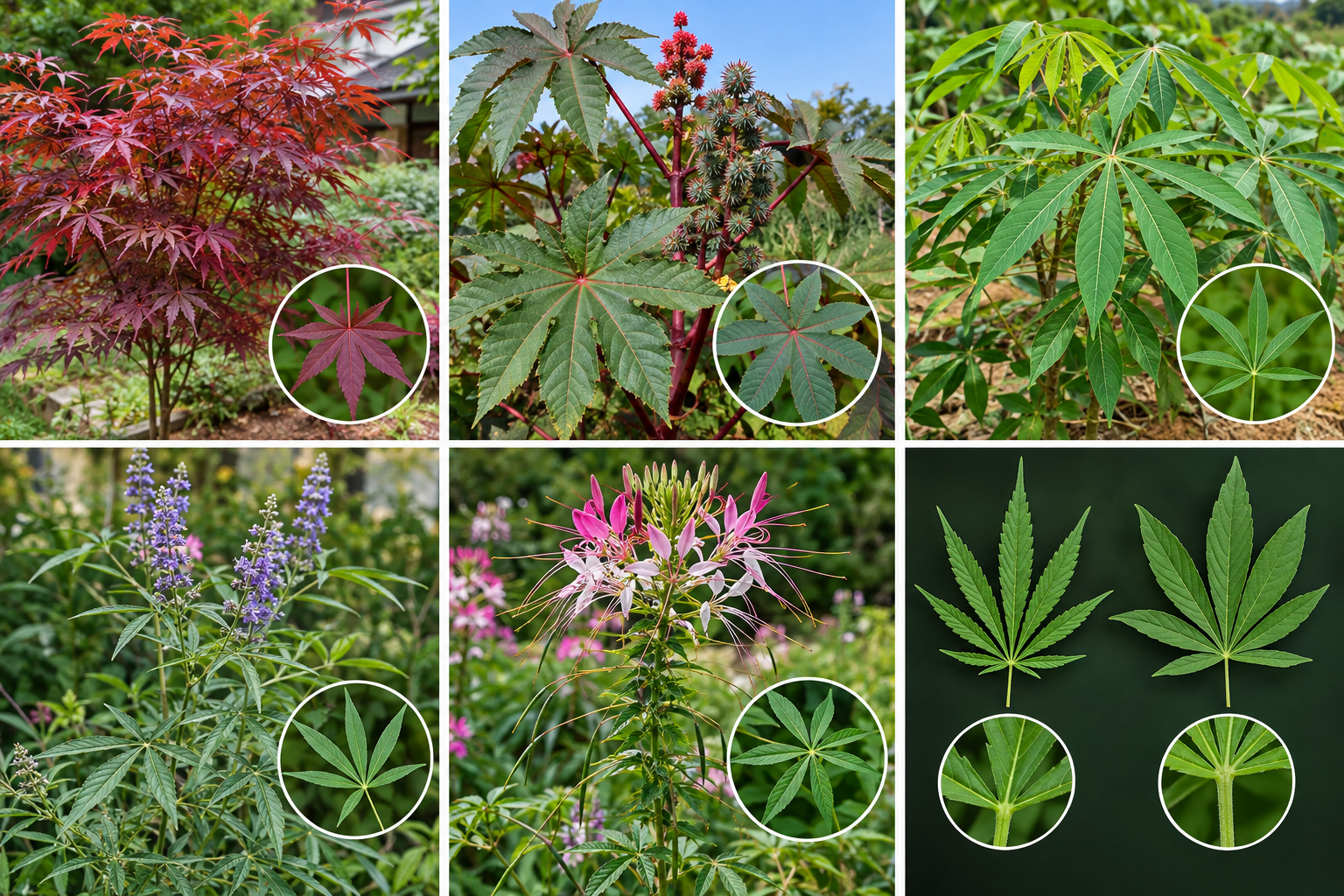
Many plants have leaves that can look surprisingly similar to cannabis at first glance. Their leaves may have several narrow sections radiating from a central point, making it easy to confuse them with marijuana plants. However, leaf shape alone is not enough to identify a plant accurately.
This guide explores some of the most common plants that look like marijuanas, explains their distinguishing characteristics, and provides practical tips for telling them apart.
Why Some Plants Look Like Marijuana
Cannabis has distinctive palmate leaves, meaning several leaflets extend from a central point. Some unrelated plants have evolved similar leaf structures, creating a visual resemblance.
The similarity can be especially noticeable when looking at young plants or photographs. However, characteristics such as leaf arrangement, texture, stem structure, flowers, growth pattern, and overall plant size can help distinguish different species.
For accurate identification, it is better to examine the entire plant rather than relying on the shape of a single leaf.
Japanese Maple
Japanese maple (Acer palmatum) is one of the plants that can sometimes be mistaken for cannabis because of its deeply divided leaves.
Its leaves usually have five to nine lobes, depending on the variety. They tend to have a delicate appearance and may appear green, red, purple, or orange throughout different seasons.
Unlike cannabis, Japanese maple is a woody tree or shrub. Its leaves are also generally broader and more ornamental in appearance.
Key identifying features:
- Deeply divided, palmate leaves
- Woody stems and branches
- Often grown as an ornamental plant
- Numerous leaf-color varieties
- Develops into a small tree or shrub
Castor Bean Plant
The castor bean plant (Ricinus communis) has large, dramatic, star-shaped leaves that can resemble oversized cannabis leaves from a distance.
Its leaves are generally much larger than cannabis leaves and have prominent veins. The plant can grow into a substantial shrub in suitable climates.
An important safety point is that castor bean seeds contain ricin, a highly toxic substance. The plant should therefore be handled responsibly, particularly around children and pets.
Key identifying features:
- Very large palmate leaves
- Strong, visible veins
- Often reddish or green stems
- Can become a large shrub
- Distinctive spiny seed structures
Cassava
Cassava (Manihot esculenta) is another plant that can be mistaken for cannabis because its leaves have several narrow lobes radiating outward.
Cassava is an important food crop in many tropical and subtropical regions. Its leaves often appear more widely separated than cannabis leaflets, and the plant develops a different overall growth structure.
Cassava is grown primarily for its starchy roots. However, proper preparation is important because raw cassava contains naturally occurring cyanogenic compounds.
Key identifying features:
- Narrow, finger-like leaf lobes
- Leaves radiate from a central point
- Woody or semi-woody growth
- Common agricultural crop in warm climates
- Grown primarily for its roots
Chaste Tree
The chaste tree (Vitex agnus-castus) has compound leaves made up of several narrow leaflets arranged around a central stem. This arrangement can create a superficial resemblance to cannabis.
It is commonly grown as an ornamental shrub or small tree. Its leaves are generally less densely arranged than cannabis leaves, while its overall woody structure makes the plant easier to distinguish when viewed as a whole.
Chaste trees can also produce clusters of small flowers, adding another useful identification feature.
Key identifying features:
- Several narrow leaflets
- Woody shrub or small tree
- Aromatic foliage
- Clusters of small flowers
- Leaflets usually arranged like fingers
Cleome, or Spider Flower
Cleome (Cleome hassleriana and related species) is an annual flowering plant whose leaves can sometimes be confused with cannabis when viewed from above.
Its leaves are composed of several elongated leaflets attached to a central point. The plant is better recognized by its tall, upright growth and distinctive flowers, which often have long stamens that give it a spider-like appearance.
Cleome is frequently grown in gardens as an ornamental flowering plant.
Key identifying features:
- Multiple narrow leaflets
- Upright growth habit
- Showy flowers
- Long flower stamens
- Usually grown as an ornamental annual
How to Tell Cannabis From Look-Alike Plants
Identifying a plant should involve more than comparing the shape of its leaves. Several characteristics can help narrow down the species.
First, examine the leaf arrangement. Cannabis leaves usually consist of multiple serrated leaflets arranged around a central point. The number of leaflets can vary, particularly depending on the plant’s age and development.
Next, examine the stem and growth habit. A woody trunk strongly suggests a tree or shrub rather than cannabis. The plant’s height, branching pattern, and overall structure can also provide useful clues.
Other useful characteristics include:
- Leaf texture and surface
- Serration along the leaf edges
- Arrangement of leaves on the stem
- Flower structure
- Fruit or seed structures
- Plant size and growth habit
- Whether the stem is herbaceous or woody
When identification matters, a clear photograph showing the whole plant, leaves, stems, and flowers is much more useful than a close-up of a single leaf.
Common Questions About Cannabis Look-Alike Plants
What plants look most like marijuana?
Several plants can have cannabis-like foliage, including Japanese maple, castor bean, cassava, chaste tree, and cleome. Their resemblance generally comes from having palmate or deeply divided leaves.
Can a Japanese maple look like cannabis?
Yes. Some Japanese maple varieties have deeply divided leaves that can look similar to cannabis leaves. However, Japanese maple is a woody plant and its leaf structure and overall growth pattern are different.
Does cassava look like marijuana?
Cassava can have a noticeable resemblance because its leaves contain several narrow lobes radiating from a central point. Its overall plant structure and leaf arrangement help distinguish it from cannabis.
Is castor bean the same as marijuana?
No. Castor bean and cannabis are completely different plant species. Castor bean has much larger leaves and develops a different growth pattern. Its seeds are also highly toxic because they contain ricin.
Can you identify a plant from its leaves?
A leaf photograph can provide useful clues, but leaf shape alone may not be sufficient for reliable identification. A photograph showing the whole plant, stem, flowers, and leaves gives much better information.
Conclusion
There are numerous plants that look like marijuanas because unrelated species can have similarly shaped, palmate, or deeply divided leaves. Japanese maple, castor bean, cassava, chaste tree, and cleome are several examples that may cause confusion.
The most reliable way to distinguish these plants is to examine more than the leaf. Consider the plant’s overall shape, stem, leaf arrangement, flowers, fruit, and growing habit. Understanding these differences makes plant identification easier and helps prevent common mistakes based on appearance alone.
