

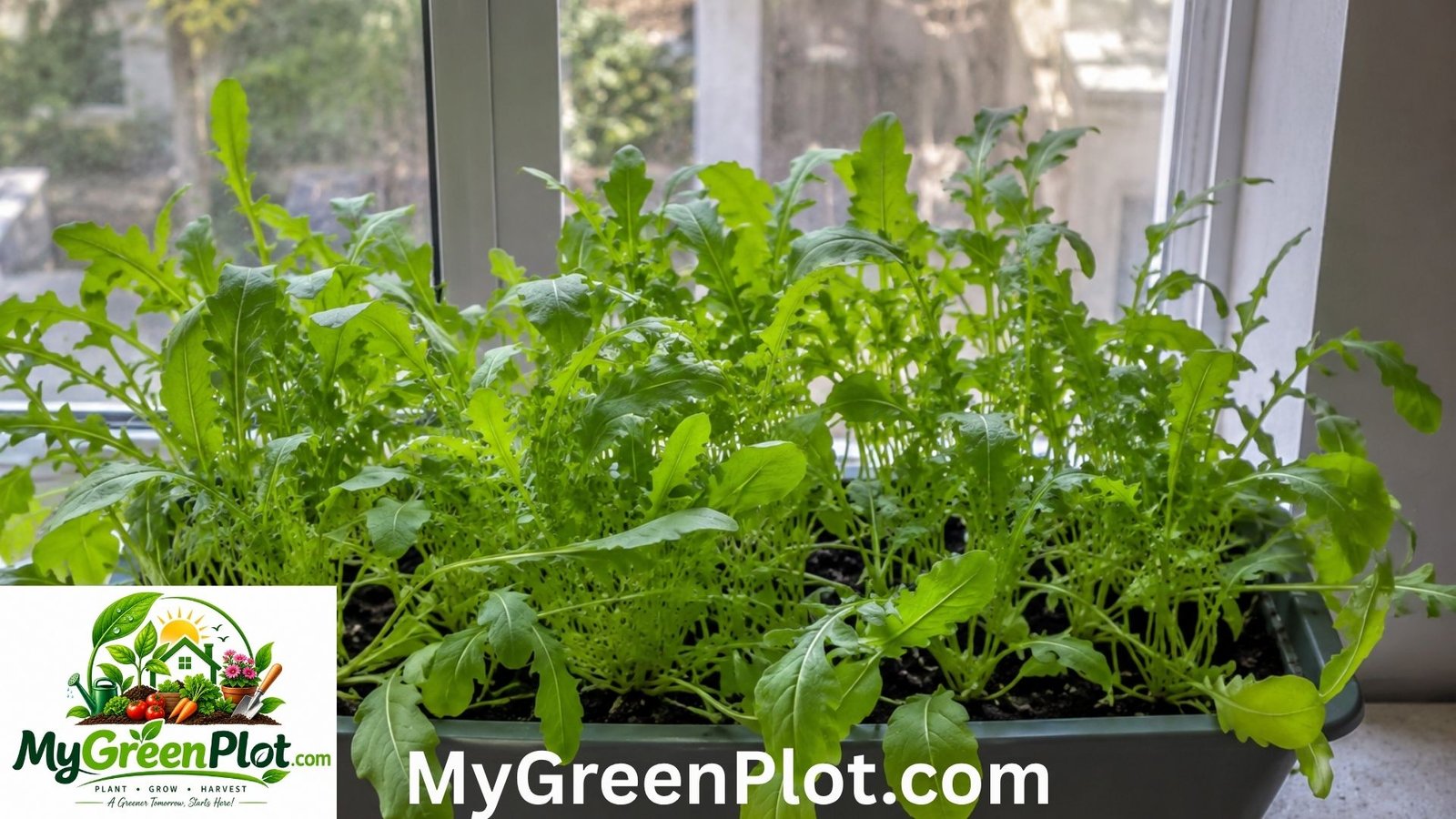
You can grow arugula indoors in a shallow container and start harvesting baby leaves in about 3–4 weeks, while full-size leaves generally take around 4–6 weeks depending on the variety and growing conditions. Arugula (Eruca sativa) is especially suited to indoor growing because it is a fast-growing cool-season crop that can tolerate less-than-perfect light better than many other leafy vegetables. Cornell Garden-Based Learning lists 5–7 days for emergence and notes that some arugula can be ready to harvest about 4 weeks after seeding.
The trick is keeping the plants cool, evenly moist, and well lit. If your indoor growing area becomes hot or the seedlings stretch toward a window, the leaves can become tougher, more pungent, and more likely to bolt.
Choose a container that gives arugula room to spread
A container that is about 4–6 inches deep is enough for growing arugula as baby leaves, provided it has drainage holes and enough surface area for the seeds. North Carolina State University recommends at least 4–6 inches of soil depth for container-grown arugula.
A wide rectangular tray is usually more useful than a tall narrow pot because arugula (Eruca sativa) produces a relatively shallow root system while its leaves spread outward. For a small indoor crop, a tray roughly 6–12 inches wide and 12–18 inches long gives you considerably more harvesting area than a small individual flowerpot.
Use a quality, well-draining potting mix rather than garden soil. Garden soil can become compacted inside containers, while a lightweight potting mix allows the fine roots of arugula seedlings to receive both moisture and air.
Make sure excess water can escape through the bottom. A container without drainage is one of the easiest ways to create persistently wet soil and weak young plants.
Give arugula cool temperatures and strong light
Arugula grows best in cool conditions, with University of Florida Extension giving a preferred range of about 50–65°F (10–18°C).
That temperature preference is one reason an indoor windowsill can work so well during cooler months. A bright kitchen window that stays around 55–65°F (13–18°C) can produce better arugula than a hot window directly above a radiator.
Light is the other major factor. University of Florida Extension recommends about 4–6 hours of sunlight for arugula, while indoor baby-green production can benefit from supplemental lighting when natural light is inadequate.
If your window does not provide enough direct light, use an LED grow light. University of Maryland Extension recommends about 16 hours of total light per day for indoor microgreens and baby greens, while Iowa State Extension gives a practical supplemental-light range of 12–16 hours per day.
Keep the LED fixture roughly 6–12 inches above the foliage, adjusting the height according to the light’s intensity and the manufacturer’s recommendations.
A simple timer makes the schedule much easier. Consistent lighting is better than leaving the grow light on randomly for several long periods.
Sow arugula seeds only ¼ inch deep
Arugula seeds should be planted about ¼ inch deep, which is shallow enough for the small seedlings to emerge quickly. Cornell Garden-Based Learning recommends sowing arugula at ¼ inch, while the University of Delaware gives a range of ¼–½ inch.
Moisten the potting mix first, scatter the Eruca sativa seeds across the surface, and cover them lightly with about ¼ inch of mix. Press the surface gently so the seeds make good contact with the growing medium.
Do not bury arugula deeply. A thin covering is enough to keep the seeds moist while allowing the emerging seedlings to reach the light quickly.
Under suitable conditions, arugula seeds can emerge in approximately 5–7 days.
For baby greens, you can sow more densely than you would for large individual plants. University of Maryland Extension recommends thinning indoor baby greens to approximately 2 inches apart as they develop.
If you want larger plants rather than dense baby leaves, give individual arugula plants roughly 3–6 inches of space. Wisconsin Horticulture recommends thinning individual plants to 3–6 inches, while denser spacing works for cut-and-come-again production.
Keep the potting mix evenly moist, not saturated
Arugula needs consistent moisture because its shallow root system can dry quickly in a small indoor container. The University of Delaware recommends a well-drained growing medium with a soil pH around 6.0–7.0 for arugula.
Check the surface of the potting mix every day during the seedling stage. If the top layer feels dry, water gently until a small amount drains from the bottom of the container.
Avoid keeping the container permanently waterlogged. Excess moisture reduces air around the roots and can contribute to seedling problems, particularly when young plants are crowded.
Bottom watering can work well for a shallow arugula tray because the growing medium absorbs moisture gradually. If you use this method, remove the tray from standing water after the mix has become evenly moist.
I prefer checking the actual growing medium rather than following a rigid schedule such as “water every two days.” Indoor temperature, container size, sunlight, and airflow can change drying speed dramatically.
Feed arugula lightly instead of constantly fertilizing it
Arugula is a fast-growing leafy vegetable, but a fresh, nutrient-containing potting mix can provide much of what a short crop needs before harvest. Iowa State Extension notes that container-grown plants generally benefit from light fertilization rather than heavy feeding.
If your arugula is being grown repeatedly in the same container, a diluted balanced fertilizer can be used according to the product label rather than applying concentrated fertilizer directly to the roots.
For a crop harvested after only 4–6 weeks, excessive fertilizer is usually unnecessary. The bigger priorities are adequate light, cool temperatures, moisture, and good drainage.
If the leaves are pale while the plants are also stretching badly toward the window, fix the lighting before assuming fertilizer is the problem. A light-starved arugula plant cannot compensate for weak light simply by receiving more nutrients.
Harvest baby arugula when the leaves are 4–6 inches tall
Indoor arugula can be harvested as baby greens when the leaves reach approximately 4–6 inches tall, according to University of Maryland Extension.
For baby-leaf production, use clean scissors to cut the outer leaves or trim the plants above the growing point, depending on how densely you planted them. Leaving the central growing area intact gives the plant an opportunity to produce additional leaves.
University of Florida Extension recommends harvesting arugula at around 8–10 inches tall for larger leaves, but younger leaves generally have a milder texture and flavor.
The flavor changes as arugula matures. Older leaves tend to become more pungent and bitter, especially when the plant is exposed to heat or begins flowering.
Harvesting little and often is therefore more useful than waiting for every plant to reach its maximum size.
Sow a new tray every 2–3 weeks for continuous leaves
Planting a new tray every 2–3 weeks is one of the easiest ways to keep indoor arugula available instead of harvesting everything from one container at once. Cornell Garden-Based Learning recommends new plantings every 2–3 weeks for a continuous supply.
For example, sow Tray A on August 1, Tray B around August 15, and Tray C around August 29. By the time Tray A is heavily harvested, Tray B can be approaching its first baby-leaf harvest.
This staggered approach also protects you from a single failed tray. If one container develops poor germination or becomes too warm, another batch is already growing.
Variety choice can also affect timing. The University of Maryland lists ‘Ice-Bred Arugula’ at about 45 days to harvest, while the University of Delaware lists ‘Rocket Wild Roma’ at about 35 days.
Leggy arugula usually needs more light
Leggy arugula seedlings with long, thin stems are usually responding to insufficient light rather than needing more water. Indoor plants naturally stretch toward a stronger light source when illumination is inadequate.
Move the container closer to a bright window or add an LED grow light positioned about 6–12 inches above the foliage. Iowa State Extension specifically recommends supplemental lighting when indoor natural light is insufficient.
Do not solve severe stretching by simply burying the long stems under extra soil. Arugula seedlings are better corrected by improving the light that caused the stretching in the first place.
Dense seedlings can also compete for light. Thin the crop to about 2 inches apart when producing baby greens so individual plants have more access to the available light and airflow.
Bitter arugula usually means the plants are too mature or stressed
Heat is a major reason arugula develops stronger, less pleasant flavor. University of Florida Extension reports that temperatures above about 85°F (29°C) can encourage rapid bolting, while Wisconsin Horticulture describes arugula as a cool-season crop that benefits from cooler growing conditions.
If your indoor arugula becomes bitter, check the temperature near the container rather than only the room thermostat. A sunny south-facing window can become substantially warmer than the surrounding room.
Harvest younger leaves before flowering begins. Once arugula (Eruca sativa) bolts, the plant shifts toward producing flowers and seeds, and the leaves can become noticeably more pungent.
Heat stress is not the only cause. Allowing the potting mix to swing repeatedly from very dry to saturated can also stress shallow-rooted plants, so consistent moisture matters alongside temperature.
Bolting can be slowed by keeping arugula cool
Arugula bolts when environmental conditions push the plant toward flowering, and heat is one of the strongest triggers. Cornell Garden-Based Learning recommends reducing heat and moisture stress to slow bolting.
For indoor growing, keep the crop away from radiators, heating vents, and unusually hot glass. A room maintained around 50–65°F (10–18°C) is much closer to the crop’s preferred conditions than a consistently hot growing area.
You can also harvest frequently rather than allowing a large mature plant to sit for weeks. Once you see a central flower stalk beginning to rise, harvest the remaining usable leaves promptly.
If bolting repeatedly ruins your indoor crop, switch from trying to grow large mature plants to a baby-green system. A 4–6-inch baby-leaf harvest gives you a faster crop and reduces the amount of time the plant has to experience stressful conditions.
The simplest indoor arugula setup is a shallow tray and LED light
A reliable indoor arugula setup needs surprisingly little equipment: a 4–6-inch-deep container with drainage, quality potting mix, arugula seed, water, and either a bright window or an LED grow light.
For the most predictable results, I would use a wide tray, sow seeds about ¼ inch deep, keep seedlings around 2 inches apart for baby greens, maintain temperatures near 50–65°F (10–18°C), and provide up to 12–16 hours of supplemental light when the window is not bright enough.
Start harvesting baby leaves at roughly 4–6 inches, then sow another tray 2–3 weeks later. That simple rotation gives you a much steadier supply of fresh arugula than waiting for one container to finish before planting the next.
Sources: Cornell Garden-Based Learning | University of Maryland Extension | University of Florida IFAS Extension | Iowa State University Extension | NC State Extension
