

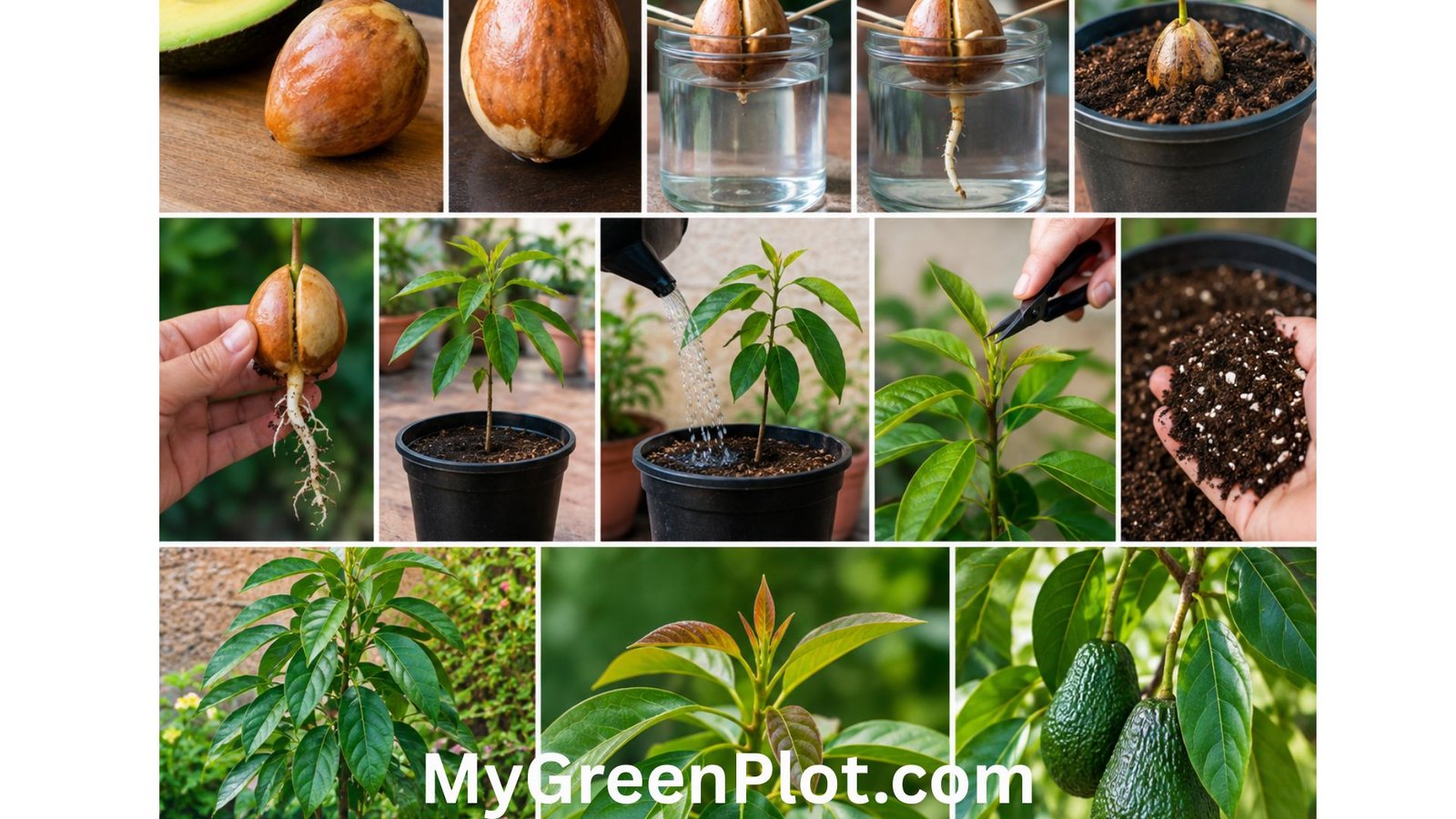
You can grow an avocado from seed by cleaning the pit, keeping its pointed end up, and maintaining steady moisture at about 20–25°C (68–77°F); most viable seeds begin showing roots or shoots within 2–8 weeks. The familiar avocado seed in water method works, but you can also plant the seed directly in potting soil, which avoids the root disturbance that comes with moving a water-grown seed later.
The important part is not the toothpicks. It is keeping the seed warm, moist, and oxygenated while it germinates.
How to plant an avocado seed after eating the fruit
An avocado seed should be planted with its broader, flatter end down and its slightly pointed end up because the root emerges from the bottom and the shoot grows from the top.
Remove the flesh from the seed of Persea americana and rinse it under lukewarm water; a thin layer of avocado pulp left on the seed can encourage mold during the 2–8 week germination period. Don’t peel off the brown seed coat unless it is already coming away easily, because forcing it off can damage the seed.
If you are planting directly in soil, use a 15–20 cm (6–8 inch) pot with drainage holes and a loose, well-drained potting mix. Bury roughly the lower half of the avocado seed and leave the upper half exposed; completely burying a wet seed makes rot more likely.
I prefer direct soil planting when I want a plant rather than a science experiment. The root develops in its permanent medium from the beginning, so you don’t have to pull a delicate water-grown root out of a jar and disturb it.
Does an avocado seed in water really grow roots?
An avocado seed in water can produce a root and shoot, but only the lower portion of the seed should touch the water.
Push 3 toothpicks evenly around the middle of the avocado seed and suspend it over a glass or jar so the bottom 2–3 cm (about 1 inch) sits in water. The upper portion should remain above the waterline because an entirely submerged seed has less access to oxygen and is more prone to rot.
Keep the jar in a warm, bright location at approximately 20–25°C (68–77°F). Replace the water every few days rather than allowing stagnant water to become cloudy or develop an unpleasant smell.
The first change may happen underground: the seed coat can split and a white root may emerge from the broad bottom. A shoot can follow weeks later. A healthy root is usually firm and pale rather than brown, slimy, or foul-smelling.
Don’t assume a seed has failed after 10 days. Avocado seeds vary considerably, and 2–8 weeks is a more useful expectation for germination than the unrealistic promise of a root appearing in a few days.
What temperature and light does an avocado seed need to germinate?
An avocado seed germinates most reliably when the growing medium or surrounding environment stays around 20–25°C (68–77°F) rather than repeatedly becoming cold.
Temperature matters because avocado seeds are tropical to subtropical plant material, and cool conditions slow the biological processes involved in germination. The University of California Agriculture and Natural Resources describes avocado as a warm-climate crop, with serious cold sensitivity in young plants.
Give a germinating Persea americana seed bright indirect light or gentle morning sun rather than placing a newly sprouted seed behind hot glass in intense afternoon sun. Light is less critical before the shoot emerges than temperature and moisture, but it becomes increasingly important once leaves appear.
Keep the soil or seed consistently moist, not waterlogged. A 6–8 inch pot with drainage is much safer than a decorative container with no hole because excess water can remain around the developing root.
When should you move a water-grown avocado seed into soil?
A water-grown avocado should be planted in soil once it has a substantial root system and an established shoot rather than waiting for a long, tangled root to fill the jar.
When the main root is several inches long and the shoot has produced leaves, move the avocado into a 15–20 cm (6–8 inch) pot containing well-drained potting mix. Handle the root gently because young avocado roots are easily damaged.
Plant the seed so that approximately the upper half remains above the soil surface, matching the planting depth used for a fresh seed. Firm the mix lightly around the root without compacting it.
Water the newly planted Persea americana thoroughly once, let excess water drain from the pot, and then keep the mix evenly moist while the plant adjusts. A water-grown root has been developing in a completely different environment, so a little temporary leaf drooping after transplanting is not unusual.
How do you care for an avocado grown from seed?
A young avocado needs strong light, free-draining soil, and enough water to keep the root zone from repeatedly drying completely.
Place the plant where it receives several hours of bright light each day; once it is acclimated, an avocado can handle direct sun, but a plant that has been growing indoors should be moved into stronger sunlight gradually to avoid leaf scorch.
Water Persea americana when the upper part of the potting mix begins to dry rather than following a rigid daily schedule. The exact interval depends on pot size, temperature, humidity, and sunlight, but constantly saturated soil is a bigger problem than missing one watering.
Avocado generally prefers slightly acidic to neutral soil, with a useful target around pH 6.0–6.5. A commercial potting mix amended for good drainage is usually more practical for a container plant than heavy garden clay.
Once the main stem reaches roughly 30 cm (12 inches), you can pinch or cut the growing tip to encourage branching if you want a shorter, bushier houseplant. I would not prune a tiny seedling with only a few leaves; let it establish a functioning root system first.
As the roots fill the container, move the avocado into a pot only 5–8 cm (2–3 inches) wider than the previous one. A huge pot holds more wet soil around a small root system and can make overwatering easier.
Will an avocado grown from seed produce avocados?
A seed-grown avocado can eventually produce fruit, but it may take 5–13 years or longer, and the fruit may be very different from the avocado that supplied the seed.
That happens because avocado varieties grown from seed do not reliably reproduce the parent tree’s genetics. The pit from a ‘Hass’ avocado, for example, does not guarantee a new tree that produces true-to-type ‘Hass’ fruit.
Commercial avocado growers solve this problem by grafting a named cultivar such as ‘Hass’ onto suitable rootstock. A grafted tree also has a much more predictable fruiting habit than a seedling.
Container-grown avocado plants face another limitation: an avocado tree that can eventually become 20–40 feet or more outdoors is difficult to keep at a size suitable for a normal indoor room. Your seedling can make an excellent foliage plant even if it never produces a useful crop of fruit.
