

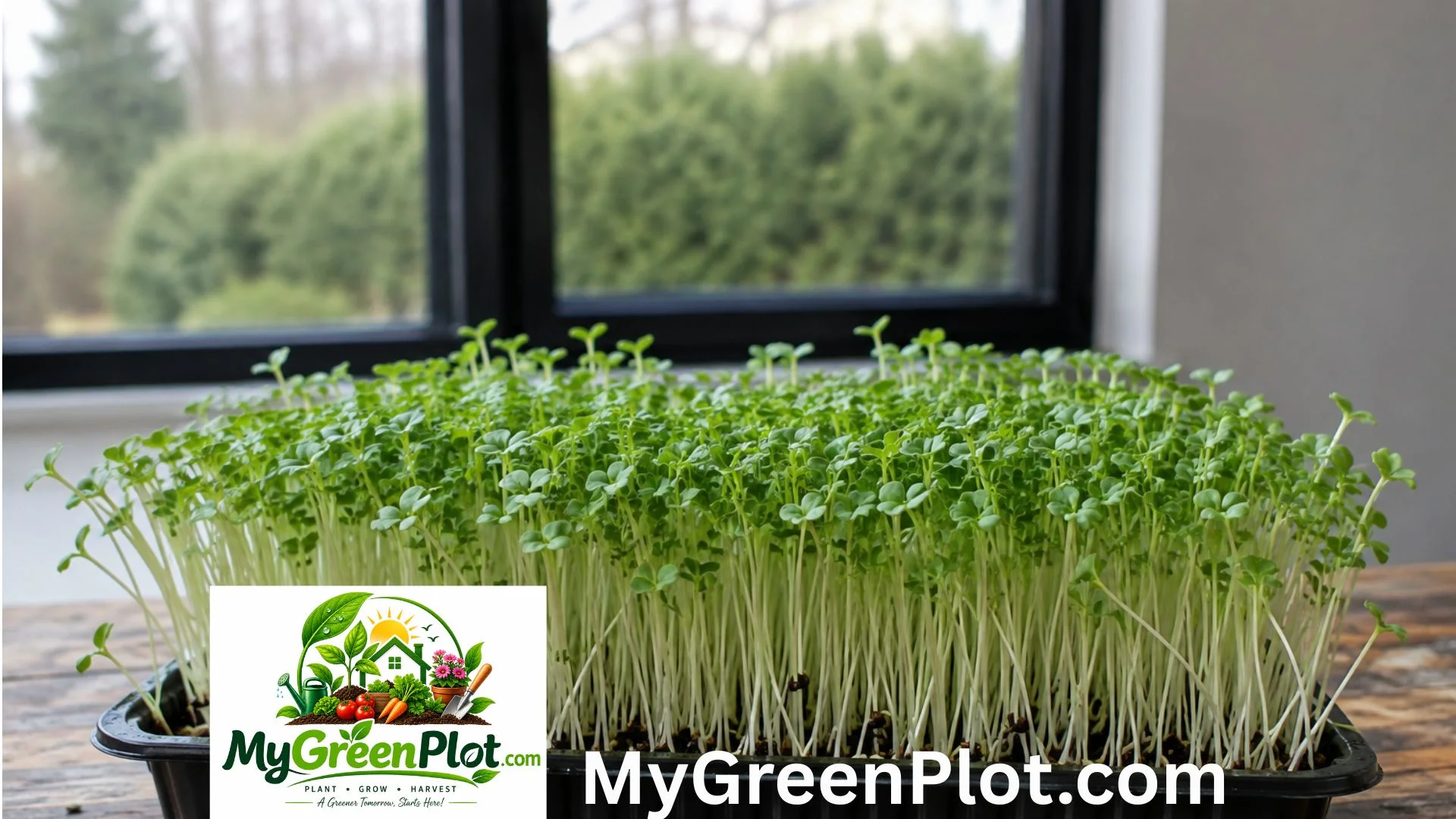
Micro greens can provide concentrated amounts of vitamins, carotenoids, and minerals in a very small serving, but their nutritional value varies considerably by plant species. A USDA Agricultural Research Service study of 25 types of microgreens found vitamin C concentrations ranging from 20.4 to 147.0 mg per 100 grams of fresh weight. Red cabbage, cilantro, garnet amaranth, and green daikon radish stood out for particular nutrients.
Microgreens are young edible seedlings harvested before they develop into mature vegetable plants. Most are only about 1–3 inches tall when harvested, which makes them practical for growing indoors on a tray, windowsill, or small shelf.
Their small size does not mean their nutritional profile is small.
1. Microgreens can provide concentrated vitamins and carotenoids
Microgreens can contain substantial concentrations of vitamin C, vitamin E, vitamin K, and carotenoids while they are still only a few inches tall.
USDA Agricultural Research Service researchers tested 25 commercially available microgreen varieties and found major differences between species. Vitamin C ranged from 20.4 to 147.0 mg per 100 g fresh weight, showing why it is misleading to treat all microgreens as nutritionally identical.
The same USDA research measured beta-carotene from 0.6 to 12.1 mg per 100 g fresh weight, while lutein and zeaxanthin also varied substantially among the tested crops.
That variation gives you a practical reason to rotate crops. Eating red cabbage microgreens one week and cilantro microgreens the next exposes your diet to different plant compounds rather than relying on one species.
2. Some microgreens contain more phytonutrients than their mature leaves
USDA research found that the tested microgreens generally had higher concentrations of several measured vitamins and carotenoids than mature leaves from the same plant species.
The USDA study compared microgreen nutrient concentrations with mature-leaf nutritional data and reported substantially greater nutrient densities in the young plants for the nutrients examined.
USDA’s research summary describes the overall difference as roughly five times higher for some measured vitamins and carotenoids, although the exact advantage depends on the plant and nutrient being compared.
That last point matters. A claim that every microgreen is automatically five times more nutritious than its mature vegetable is too broad.
Broccoli microgreens, for example, should not be treated as a universal replacement for mature broccoli. The two foods have different serving sizes, textures, nutrient profiles, and culinary uses.
3. Microgreens can supply useful minerals
Brassica microgreens can provide minerals such as potassium, calcium, magnesium, iron, and zinc.
A USDA study examining 30 Brassicaceae microgreen varieties measured potassium concentrations from 176 to 387 mg per 100 g fresh weight and calcium from 39 to 98 mg per 100 g.
The same research found iron concentrations of approximately 0.47–0.84 mg per 100 g and zinc concentrations of 0.22–0.51 mg per 100 g, demonstrating that mineral content also changes between varieties.
For a home grower, this means choosing different crops can change what you get from the tray. Savoy cabbage microgreens recorded the highest calcium concentration in that 30-variety Brassica study at 98 mg per 100 g fresh weight.
4. Red cabbage microgreens are particularly interesting for vitamin C
Red cabbage microgreens were among the strongest vitamin C performers in USDA testing of 25 microgreen varieties.
The USDA research identified red cabbage microgreens as having the highest vitamin C concentration among the varieties tested in that study.
Vitamin C is water-soluble, so microgreens are best treated as one food contributing to overall dietary intake rather than as a concentrated supplement.
I like red cabbage microgreens for another reason: their purple-red leaves add color without requiring a large portion. A handful can change the appearance and texture of a sandwich or salad.
5. Cilantro microgreens provide a different nutritional profile
Cilantro microgreens ranked among the highest vitamin C-containing microgreens in the USDA study of 25 varieties.
The research found that different microgreens excelled in different nutrients, with red cabbage standing out for vitamin C and cilantro among the strongest performers for carotenoids in the tested group.
Cilantro microgreens also give you something mature cilantro does not provide in exactly the same way: a very tender stem and small leaves that can be harvested around 1–3 inches tall.
Their flavor is recognizable but milder and more delicate than a mature bunch of cilantro, making them useful as a fresh topping rather than only as a cooking herb.
6. Microgreens can add nutrients without requiring a large garden
Microgreens can be harvested in roughly 7–14 days after germination for many crops, allowing a small growing space to produce edible greens quickly.
USDA describes microgreens as young vegetables and herbs harvested at approximately 1–3 inches tall, with many crops harvested about 7–14 days after germination.
A separate USDA-supported study examining 17 microgreen species harvested the crops approximately 10–19 days after sowing, depending on species.
That short cycle makes microgreens useful when you have no outdoor garden. A shallow tray, suitable growing medium, seeds, water, and adequate light can produce a harvest much faster than crops such as carrots or head lettuce.
7. Different microgreens can target different nutrients
The nutritional profile of microgreens is strongly influenced by the species and variety you grow.
USDA researchers found significant differences in mineral accumulation among 30 Brassicaceae microgreen varieties, while another controlled study of 17 species from 7 plant families also found substantial differences in mineral profiles and yield.
That makes crop selection more useful than simply buying the word “microgreens.” Red cabbage, radish, amaranth, sunflower, basil, arugula, and broccoli do not produce identical nutritional profiles.
If your goal is variety, grow several species rather than filling every tray with one seed type.
8. Growing conditions can change microgreen nutrition
Light intensity, plant genetics, growing conditions, and harvest timing can influence the nutrient composition of microgreens.
USDA research notes that growing, harvesting, and handling conditions can affect nutrient retention in microgreens.
A 2023 USDA-supported study also found that mineral accumulation differed substantially between species and that genotype was an important factor determining mineral profiles. The researchers harvested their 17 tested species between 10 and 19 days after sowing.
So two trays labeled “microgreens” can provide different nutritional results even when both look healthy. Sunflower microgreens, for example, have a different mineral profile from red cabbage microgreens because they are different plants with different nutrient accumulation patterns.
9. Fresh microgreens are useful because they combine nutrition with flavor and texture
Microgreens provide a practical way to add fresh plant foods to meals without using a large volume of mature vegetables.
USDA describes microgreens as having intense flavors, vivid colors, and crisp textures, which explains why they work well in salads and as garnishes.
A tray of radish microgreens can add peppery flavor to a sandwich, while pea shoots provide a sweeter, more vegetal taste and a different texture.
The nutritional advantage also works best when you actually eat the greens. A small handful of fresh broccoli microgreens added to lunch is more useful nutritionally than leaving an entire tray unharvested because you are waiting for it to become a full-sized vegetable.
Are microgreens healthier than regular vegetables?
Microgreens can be especially nutrient-dense for certain vitamins, carotenoids, and minerals, but they should complement mature vegetables rather than replace them completely.
The strongest evidence concerns particular nutrients measured in particular species. USDA studies have repeatedly shown that nutrient concentrations vary significantly among microgreen types, so there is no single nutritional score that applies equally to kale, radish, basil, sunflower, and amaranth microgreens.
Mature vegetables also provide useful fiber, nutrients, and phytochemicals in larger serving sizes. A practical diet can therefore include both forms: mature broccoli as a substantial vegetable serving and broccoli microgreens as a fresh addition to sandwiches, salads, or bowls.
One other detail matters when growing them yourself: microgreens have a short postharvest life. A USDA-published review notes that harvested microgreens can rapidly lose quality through dehydration, wilting, and decay, which is one reason local production and quick consumption make sense.
Sources: USDA Agricultural Research Service | Journal of Agricultural and Food Chemistry | Journal of Food Composition and Analysis | Frontiers in Plant Science
