

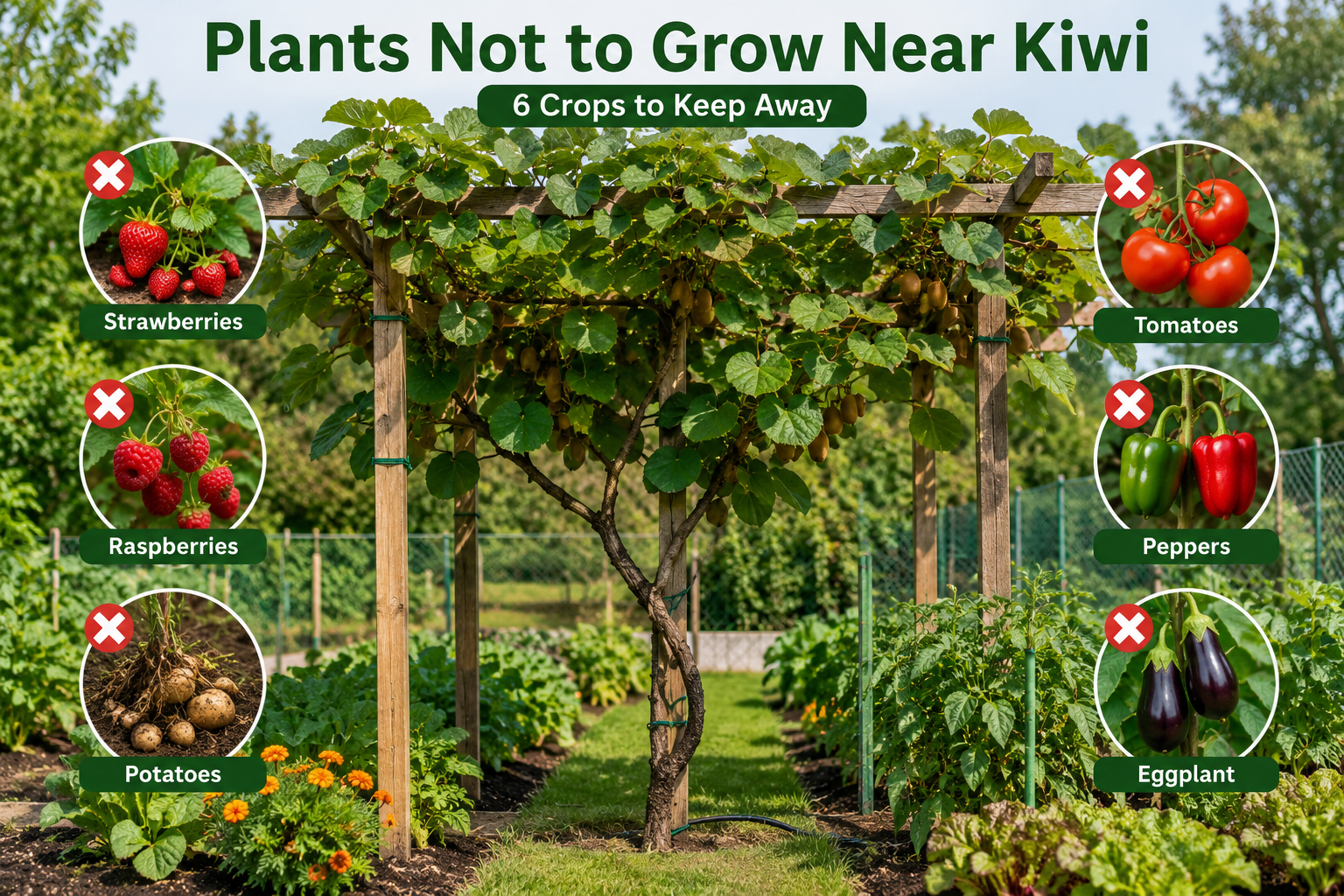
The plants not to grow near kiwi are mainly strawberries, raspberries, potatoes, tomatoes, peppers, and eggplant when they have a history of Verticillium wilt, plus aggressive plants that compete heavily for the kiwi’s water and root space. Kiwi vines need roughly 10–15 feet of planting space, and their canes can grow 6–12 feet in a single year, so crowding becomes a real problem quickly.
There is no strong scientific evidence that kiwi has a special list of plants that are chemically “bad companions.” The bigger concern is what another plant does to the soil, roots, water supply, sunlight, and physical space around Actinidia.
Avoid strawberries, raspberries, potatoes, tomatoes, peppers and eggplant where Verticillium is a concern
Strawberries, raspberries, potatoes, tomatoes, peppers, and eggplant can be poor choices before kiwi if Verticillium wilt has affected the planting area. Oregon State University Extension specifically recommends avoiding kiwi sites where these Verticillium-susceptible crops have been grown during the previous five years.
The issue is not that a healthy tomato plant sitting beside a healthy kiwi vine automatically harms it. The problem is the soil history. Verticillium is a soil-dwelling fungal disease, and infected soil can remain a problem after the original crop has been removed.
If your old tomato bed had severe Verticillium wilt, moving a kiwi vine into that same soil is a much bigger concern than whether tomatoes are physically planted 2 or 3 feet away. OSU Extension lists strawberries, raspberries, potatoes, tomatoes, peppers and eggplant among crops that can carry this risk.
So if you are choosing a location for a new kiwi vine, think about what grew there during the last five years, not just what you plan to plant this season.
Don’t put thirsty plants inside the kiwi’s main root zone
Kiwi vines need a consistent water supply, so thirsty plants packed around the trunk can compete with young vines for moisture. OSU Extension recommends about 2 inches of water per week during the growing season, although the exact requirement varies with climate, vine age and irrigation method.
Young kiwi vines are particularly vulnerable to competition because their root systems are still developing. OSU Extension recommends keeping approximately 4 feet around the trunk free of weeds, because weeds compete with kiwi for water and nutrients.
That principle applies to intentionally planted vegetation too. A large, thirsty plant does not become harmless simply because you call it a companion plant.
I would keep vegetables, dense groundcovers and other vigorous plants outside that immediate 4-foot zone, especially during the first few years while the kiwi is establishing.
Avoid plants with aggressive roots that turn the kiwi bed into a competition zone
Large, vigorous plants can compete with kiwi for the same water and nutrients even when they do not share a specific disease. Kiwi has a large root system and performs best in deep, well-drained soil with adequate moisture.
Trees are a particularly poor choice immediately beside a kiwi trellis. A mature tree can create a much larger root system than a small garden crop, while its canopy can also reduce the full sun that kiwi needs for good fruit production.
OSU Extension recommends full sun for kiwi and notes that partial shade can reduce yield and fruit quality.
That means planting a fast-growing tree next to your kiwi may create two problems at once: root competition below ground and shade above ground.
Keep large trees and shrubs far enough away that their mature canopy and root system will not eventually occupy the kiwi’s growing space. The exact distance depends on the mature size of the tree, so planning for the plant’s adult dimensions is more useful than choosing an arbitrary “companion plant” distance.
Don’t plant other vigorous vines where they can climb into the kiwi
Fast-growing climbing plants should not share the kiwi’s trellis because kiwi canes can grow 6–12 feet per year and occasionally reach 20 feet.
A kiwi vine already needs substantial structural support. OSU Extension recommends strong trellises or arbors because mature vines become large and heavy.
Adding another vigorous climber to the same support can make pruning much harder and can cause the plants to become tangled. Kiwi also needs regular pruning to control its strong growth.
This is why I would avoid putting vigorous climbing plants such as grapes, wisteria or aggressive ornamental vines directly onto the same structure as kiwi. The problem is not a mysterious chemical incompatibility. It is simply that two powerful vines competing for one trellis can become a maintenance headache.
Give the kiwi its own support and keep other climbers on separate structures.
Don’t use plants that encourage a wet, poorly drained planting area
Kiwi roots are highly sensitive to prolonged waterlogging, and roots can be severely damaged when soil remains saturated for three days or longer.
This makes dense planting in a naturally wet corner of the garden a poor strategy. Kiwi prefers deep, well-drained soil, with an ideal soil pH of approximately 5.6–6.0.
The problem here is bigger than the identity of one neighboring plant. If surrounding vegetation encourages you to keep the soil constantly wet, or if dense planting prevents the surface from drying normally, the kiwi’s root environment can become unfavorable.
Do not try to solve a drainage problem by simply adding more plants. If water regularly stands around the kiwi, improve drainage before worrying about companion planting.
Raised beds can help in poorly drained locations. OSU Extension notes that kiwiberries in Oregon benefited from raised beds at least 1 foot high in suitable situations.
Keep plants that create heavy shade away from the kiwi canopy
Kiwi produces better fruit in full sun, while excessive shade can reduce yield and fruit quality.
A small herb or low-growing plant several feet away is very different from a mature tree whose canopy eventually covers the kiwi trellis.
This distinction matters when planning a permanent garden. Kiwi vines can produce for more than 20 years under suitable conditions, according to OSU Extension, so a plant that looks small when you install it can become a major source of shade later.
Before planting a tree beside kiwi, look at its mature height and canopy spread. A 3-foot nursery tree can eventually become a 30-foot tree, while the kiwi will also occupy a large horizontal area.
The best kiwi location is therefore an open, sunny site rather than a narrow planting strip surrounded by large plants.
What can you plant near kiwi instead?
Low-growing plants that stay outside the kiwi’s immediate root zone are generally easier neighbors than large, thirsty or aggressive plants. The safest approach is to protect the kiwi’s core growing area rather than search for a magical companion plant.
Keep approximately 4 feet around the kiwi trunk free of weeds, then use suitable mulch or carefully selected low-growing plants farther away. OSU Extension recommends materials such as sawdust, wood chips or bark for weed suppression and moisture conservation.
If you want vegetables nearby, place them beyond the kiwi’s main weed-free zone and monitor the soil moisture rather than assuming they are automatically compatible.
A simple layout works well:
Kiwi trunk → 4-foot weed-free zone → low-growing garden plants → separate vigorous vines or large shrubs farther away.
That arrangement protects the kiwi from the most common forms of competition while still allowing you to use the surrounding garden space.
The bigger issue is usually not the plant name
For kiwi, planting-site conditions matter more than most companion-planting lists suggest. The evidence from university extension guidance focuses on drainage, soil disease history, sunlight, water, spacing and weed competition rather than a long list of plants that are inherently poisonous or incompatible with kiwi.
If you are choosing a new location, prioritize 5.6–6.0 soil pH, good drainage, full sun, adequate water, and about 10–15 feet of space for the vine before worrying about companion plants.
And if a particular crop has previously suffered from Verticillium wilt, do not plant kiwi there simply because the crop has been removed. The soil history can remain relevant for years.
Sources: Oregon State University Extension Service | Penn State Extension | University of Minnesota Extension
