

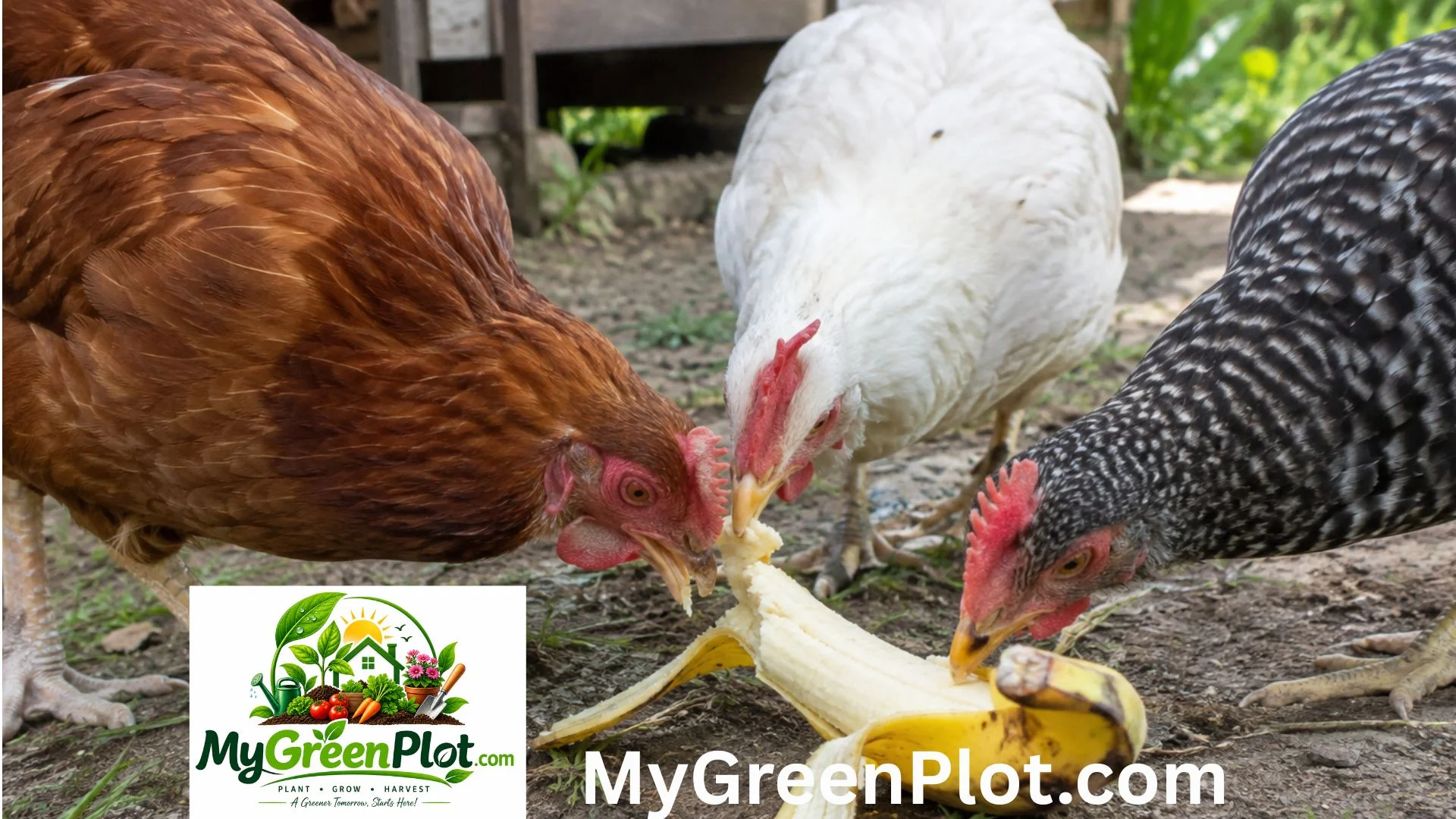
Yes, chickens can eat ripe banana, and a small piece makes a suitable occasional treat for backyard chickens. Banana is soft enough for chickens to peck apart, and its carbohydrate and potassium content make it a food they can digest, but it should remain a supplement rather than replace their complete poultry ration. The University of Kentucky’s Small and Backyard Poultry program explains that chickens need formulated feed to supply their energy, protein, vitamins, and minerals.
The practical part is simple: give your chickens a few small pieces of fresh, ripe banana, let them finish it, and keep their regular feed available. You do not need to turn banana into a daily part of the flock’s diet.
There is also an important distinction between feeding a piece of banana and using banana products as an ingredient in poultry feed. Research has investigated banana flour and banana peel as feed ingredients, but those studies do not mean that a backyard flock needs banana to stay healthy.
Can chickens eat ripe banana safely?
Ripe banana flesh is an appropriate occasional treat for chickens when it is served in small pieces and does not replace their balanced feed.
A ripe Musa banana is soft, sweet, and easy for chickens to break into bite-sized pieces. You can peel it and cut the flesh into small chunks, mash it into a shallow dish, or let the flock peck at a small piece.
The bigger nutritional issue is not banana toxicity; it is diet dilution. A complete chicken ration is formulated to provide the protein, energy, vitamins, and minerals a bird needs, while fruit supplies a much narrower collection of nutrients. Penn State Extension specifically advises chicken owners to avoid high levels of human food and scraps because they can interfere with the bird’s normal ration.
That is why I would treat banana the same way I treat other backyard treats: useful for variety, but never the foundation of the diet.
Click The Latest:Can Chickens Eat Coconut Flakes
How much banana can chickens eat?
Banana should make up only a small portion of a chicken’s daily food because excessive treats can dilute the nutrients supplied by complete poultry feed.
An exact banana allowance does not exist for every chicken because a 4-pound laying hen, a 6-pound rooster, and a young pullet have different nutritional needs. Instead of measuring banana as a fixed percentage for every bird, keep the serving small enough that it remains clearly a treat.
Extension poultry guidance commonly recommends keeping supplemental foods limited; an Extension expert responding to a backyard flock question recommended keeping additional feed such as sprouted grains below about 10% of the total diet.
For a small flock, a practical serving is a few slices shared among several adult chickens rather than an entire banana per bird.
If six hens finish half a banana quickly, that is very different from leaving several bananas in the run every day.
Watch the flock’s behavior, too. If your hens begin ignoring their layer ration because they are waiting for fruit, reduce the treats.
Can chickens eat banana peels?
Chickens can consume banana peel, but the peel is much tougher and more fibrous than the soft fruit, so it is better treated as an optional food rather than a necessary chicken treat.
Banana peel has attracted attention in poultry nutrition because it contains useful nutrients and plant compounds. A 2025 review in Poultry Science reported approximately 6–9% crude protein and 43.2–49.7% total dietary fiber in banana peel.
That does not mean you should simply throw a whole thick banana peel into the chicken run.
The research literature includes processed banana by-products, including dried peel and fermented banana material, rather than ordinary fresh peel tossed to backyard hens. One poultry study found that dried banana peel could be incorporated into laying-hen diets at experimental levels, while another study examined unripe banana flour at 5% of broiler diets.
Those are formulated-feed experiments, not instructions to replace chicken feed with banana peel.
If you want to offer peel, wash the banana first and cut the peel into small strips. I would prioritize the soft fruit and treat the peel as optional.
Should you peel bananas before giving them to chickens?
Peeling the banana makes the treat easier to eat, although clean banana peel can also be offered in small pieces if your chickens actually consume it.
A whole banana is not dangerous simply because it is whole, but a peeled banana is much easier to divide among several birds.
Cutting the fruit into pieces also lets you control the portion. If you have four hens, for example, you can offer a few small chunks rather than putting an entire banana in the run and allowing the dominant birds to eat most of it.
Freshness matters more than presentation.
Do not give chickens banana that has visible mold, a rotten smell, or extensive decomposition. A brown, soft banana is different from a moldy or spoiled one.
Do chickens like banana?
Many chickens will readily peck at sweet, soft fruit, although individual birds can refuse banana even when other flock members eat it.
Chickens are omnivores and naturally investigate a wide range of edible material while foraging. The University of Kentucky notes that chickens search for insects, worms, grains, and plant material even when complete feed is available.
That exploratory behavior explains why a new fruit often attracts immediate attention.
I would introduce banana by placing a small amount in a clean, shallow dish or on a clean area of the run. If the birds ignore it, remove it rather than assuming they need encouragement.
There is no nutritional reason to force a chicken to eat banana.
Can baby chicks eat banana?
Baby chicks should not depend on banana because chick starter feed is specifically formulated to meet the nutritional requirements of rapidly growing birds.
Penn State Extension recommends chick starter feed during the first 0–6 weeks, with the starter ration supplying the concentrated nutrients young birds need for growth.
A tiny taste of ripe banana is not the same thing as feeding a chick a banana-based diet.
For very young chicks, however, there is little reason to introduce fruit when a properly formulated starter ration already provides the appropriate nutrition.
Young birds also have smaller bodies, so a piece that seems tiny to an adult hen can represent a much larger proportion of a chick’s food intake.
For chicks, keep the focus on age-appropriate starter feed and clean water.
Can chickens eat frozen banana?
Frozen banana can be offered as an occasional enrichment treat, especially during hot weather, but it should remain a small supplement to the regular ration.
Penn State Extension specifically notes that frozen fruits and vegetables can be used as enrichment during hot weather, provided treats are given in moderation so they do not dilute the birds’ normal diet.
You can peel a ripe banana, slice it into small pieces, and freeze the pieces before offering a few to the flock.
Do not give chickens a huge frozen block of banana simply because temperatures are high.
During heat waves, the more important management issue is water. Penn State reports that poultry heat stress can occur when temperatures reach the 80s and 90s°F, with reduced feed consumption and production possible as heat stress increases.
Frozen banana can provide enrichment. It is not a substitute for cool, clean drinking water.
Does banana improve egg production?
There is not good evidence that feeding ordinary fresh banana to backyard hens directly increases egg production.
This is one of the claims I would be careful about repeating.
Bananas contain useful nutrients, and researchers have investigated banana-derived ingredients in poultry diets, but that is not evidence that giving a laying hen extra banana will make her produce more eggs.
Egg production depends on factors such as breed, age, lighting, protein and energy intake, calcium availability, water, temperature, and overall health.
Penn State Extension recommends a complete layer ration for laying hens and emphasizes that diluting the ration with excessive treats can create nutritional problems.
So if your goal is more consistent egg production, improving the flock’s complete diet is much more important than adding fruit.
Does banana peel provide useful nutrients to chickens?
Banana peel contains fiber, minerals, and other plant compounds, but its high fiber content makes it very different from the concentrated nutrition in commercial poultry feed.
The 2025 Poultry Science review reported that banana peel contains roughly 43.2–49.7% total dietary fiber on the reported basis, along with 6–9% crude protein.
Those numbers explain why banana by-products have attracted research interest.
Researchers can dry, grind, ferment, or otherwise process banana material before incorporating it into a formulated feed. Processing can change digestibility and the availability of nutrients.
A backyard chicken eating a fresh banana peel is doing something completely different.
You do not need to calculate crude protein or fiber for an occasional peel. Just remember that a chicken’s main ration is designed around its nutritional requirements, while fruit and scraps are extras.
Can chickens eat overripe banana?
A very soft brown banana can be offered if it is still fresh and free from mold, but rotten or moldy banana should go into the compost or trash instead.
Bananas become softer and sweeter as they ripen, which can make them easier for chickens to eat.
The line to watch is spoilage.
A banana with brown skin and soft flesh is not automatically spoiled. A banana with visible mold, a fermented or rotten odor, leaking liquid, or extensive decomposition should not be fed.
This is the same principle used for other table scraps: University poultry guidance warns that scraps should not be allowed to rot because spoiled food can create serious health risks.
Give your flock only what it can consume promptly, then remove leftovers rather than allowing fruit to sit in warm, damp litter.
Do chickens need grit when eating banana?
Soft banana does not require the same mechanical grinding as hard grains, but chickens still need access to appropriate grit when they consume whole foods that require grinding.
Chickens do not have teeth, so their digestive system uses the gizzard to mechanically break down feed.
University poultry guidance recommends commercial grit for chickens that consume forage and other foods because grit helps grind material in the digestive tract.
Banana flesh is soft enough that grit is not the main concern when a hen eats a few pieces.
The situation changes when your flock also eats grains, seeds, grass, insects, and other harder material.
For a backyard flock that spends time outdoors, providing suitable poultry grit is a sensible part of basic feeding management.
What is the best way to feed banana to chickens?
The simplest method is to cut a ripe banana into small pieces and offer only enough for the flock to finish as a treat.
You can use several approaches:
- Sliced: Cut the peeled banana into small rounds and scatter a few pieces for the flock.
- Mashed: Mash ripe banana into a shallow dish for birds that prefer soft food.
- Frozen: Freeze small pieces and offer them during hot weather as occasional enrichment.
- With peel: Wash the banana and cut the peel into thin strips if you want to let the chickens investigate it.
Avoid mixing banana into the birds’ entire feeder of layer ration.
That makes it harder to control how much complete feed each bird receives.
The University of Minnesota and Penn State both emphasize the same basic principle: treats should be moderate and should not replace a balanced poultry diet.
Can chickens eat banana every day?
Chickens can have banana repeatedly, but giving banana every day is unnecessary and can become a problem if the fruit displaces too much complete feed.
A hen’s nutritional requirements are met primarily through her formulated ration, not through a rotating collection of fruits.
If you offer banana several times per week, keep the portions small and watch whether the birds continue eating their normal feed.
If they start waiting for banana while leaving their ration behind, the treat is becoming too large a part of the diet.
That matters because excessive treats can dilute protein and other nutrients. An Extension poultry response specifically warns that too many treats can contribute to nutritional deficiencies and recommends moderation.
A chicken does not need banana to remain healthy.
It can simply be a small piece of fruit that adds variety to an otherwise properly balanced diet.
Sources: University of Kentucky Small and Backyard Poultry | Penn State Extension | University of Minnesota Extension | Poultry Science | U.S. Cooperative Extension
