

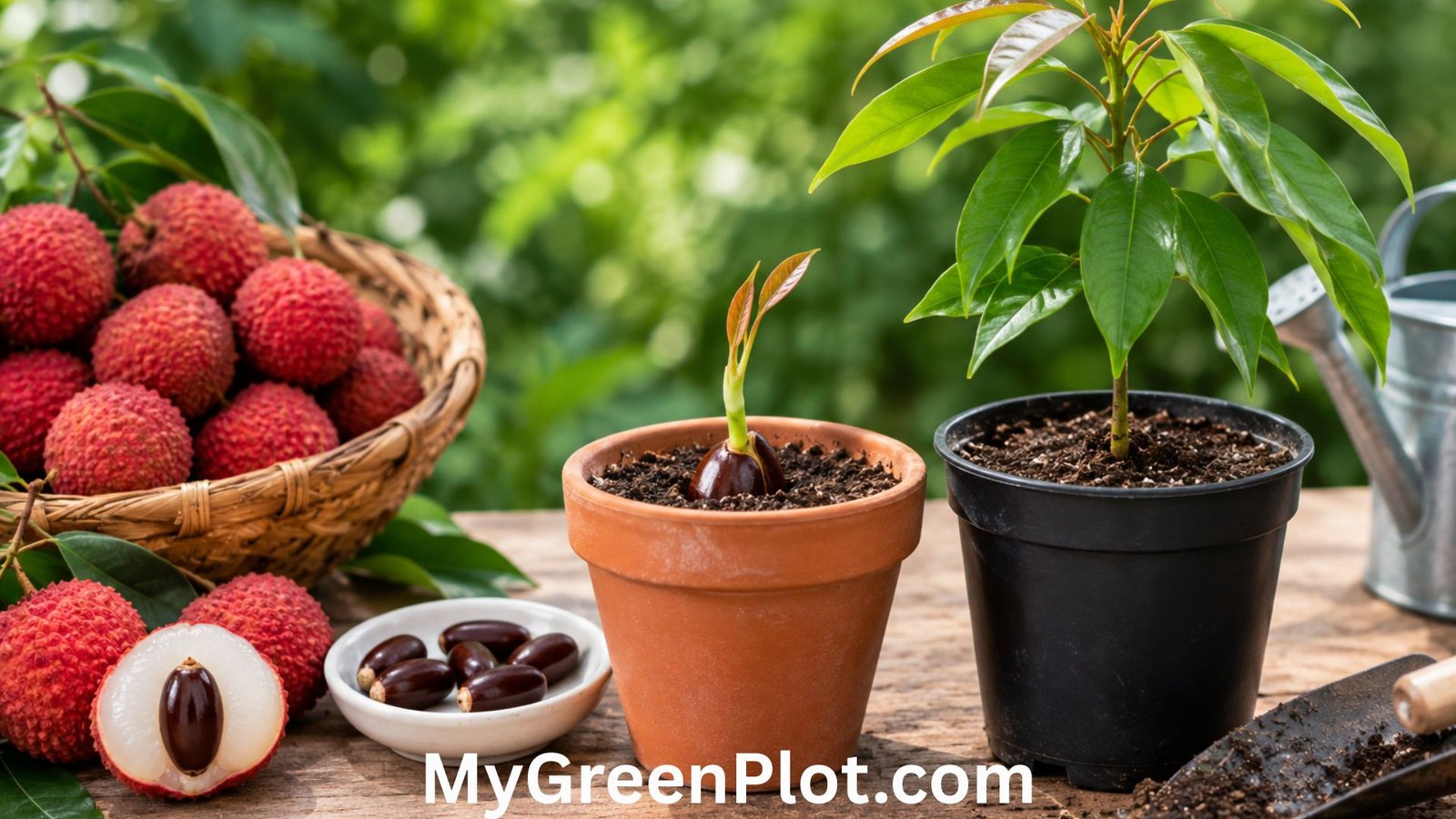
You can grow lychee (Litchi chinensis) from a fresh seed taken directly from a ripe fruit. Remove the seed, wash away the pulp, and plant it about 1–2 cm deep in moist, well-draining potting mix. Keep the pot warm, ideally around 24–29°C, and give the seed several weeks to germinate. Growing a healthy seedling is achievable at home, but producing fruit is a much longer undertaking: seed-grown lychee trees can take 10 years or more to bear fruit.
Choose a fresh seed rather than a dried one
A freshly removed lychee seed has a better chance of germinating than one that has dried out for several days. Lychee seeds are short-lived, so plant yours as soon as possible after eating the fruit instead of saving it for a future growing season.
Choose a ripe lychee with a firm, plump, brown seed. Avoid seeds that are shriveled, split, or soft from decay. Some lychee varieties naturally produce small, poorly developed seeds, so seed size alone does not guarantee successful germination.
Remove all the white fruit flesh and rinse the seed under clean water. Leftover pulp can decompose in the growing medium and encourage mold.
Plant the lychee seed in a small pot
A pot approximately 10–15 cm wide with drainage holes provides a practical starting place for one lychee seed. Use a loose potting mix that retains some moisture while allowing excess water to escape.
Fill the pot with the mix and make a hole about 1–2 cm deep. Place the seed inside, cover it gently, and water until the medium is evenly moist. Do not compress the soil tightly over the seed because the emerging shoot needs to push through it.
Keep the pot in a warm location where temperatures remain near 24–29°C. Cold potting mix can slow germination, while saturated soil can deprive the developing seed of oxygen and encourage rot.
Check the moisture regularly. Water when the surface begins to dry rather than following a rigid daily schedule.
How long does a lychee seed take to sprout?
A fresh lychee seed may sprout within a few weeks under warm, moist conditions, although the exact timing varies with seed quality and temperature. Do not discard a firm seed simply because it has not produced a shoot after seven days.
Keep the pot in its original position while the seed germinates. Repeatedly digging into the soil can damage the emerging root before it becomes visible above the surface.
If several weeks pass without growth, check whether the mix has become too dry or waterlogged. A seed that has turned soft or developed an unpleasant smell may have rotted; a firm seed may need more time.
Once the shoot appears, continue maintaining moderate soil moisture. Allow excess water to drain freely after each watering.
Give the young lychee seedling enough light
A newly emerged lychee seedling needs bright light to develop sturdy growth and healthy leaves. Place it near a bright window or in a sheltered outdoor location, introducing stronger direct sunlight gradually.
Young lychee leaves may emerge reddish or bronze before turning green as they mature. This color change is a normal feature of lychee growth, not necessarily a sign of nutrient deficiency.
Water when the upper layer of potting mix starts to dry, adjusting the frequency to the temperature and container size. A small pot exposed to hot weather can dry much faster than a larger pot kept indoors.
Avoid leaving the container in a saucer full of water. Lychee prefers consistent moisture, but roots still need oxygen, and prolonged waterlogging increases the risk of root damage.
When should you move a lychee seedling into a bigger pot?
Move your lychee seedling into a larger container when its roots begin filling the pot or emerging through the drainage holes. Choose a container only a little wider than the existing one so the surrounding soil does not remain wet for too long.
Use fresh, well-draining potting mix and handle the root ball gently during transplanting. Water after repotting to settle the mix around the roots, then keep the plant in bright, sheltered light while it adjusts.
Do not rush to fertilize a newly transplanted seedling with a strong fertilizer. Allow it to resume active growth first, then use a suitable balanced fertilizer according to its label directions.
Can a lychee grown from seed produce fruit?
A seed-grown lychee can eventually produce fruit, but it may take 10 years or longer, and the fruit may not match the variety from which the seed came. The University of Florida IFAS Extension explains that lychee seedlings do not grow true to the parent and are generally less predictable than vegetatively propagated trees.
A seedling is therefore a good choice if you enjoy growing plants and can wait to see how the tree develops. It is a less reliable choice if your main goal is to harvest a particular variety of sweet lychee.
For earlier and more predictable fruit production, consider an air-layered or grafted tree from a reputable nursery. According to the University of Florida IFAS Extension, vegetatively propagated lychee trees can begin bearing in approximately 3–5 years, depending on their growing conditions.
Can you grow lychee outdoors in Pakistan?
Lychee can grow in suitable warm regions of Pakistan, but the success of an outdoor tree depends on local temperatures, humidity, soil drainage, and winter conditions. A young plant in a pot is easier to protect from cold spells and extreme heat than a mature tree planted in the ground.
In hot weather, protect a small seedling from harsh afternoon sun while it establishes, and check its potting mix more frequently as temperatures rise. Avoid planting it in a location where heavy rain regularly leaves the roots submerged.
Lychee is sensitive to freezing temperatures, particularly while young. The University of Florida IFAS Extension reports that young trees can be damaged at temperatures of approximately −2 to 0°C, so frost-prone locations require protection.
Before planting a seed-grown tree permanently outdoors, consider how much space it will eventually need. Mature lychee trees can reach approximately 9–15 m in height and width in favorable conditions, making them unsuitable for many small gardens unless their growth is managed appropriately.
Sources: University of Florida IFAS Extension | Gardening Know How | Food and Agriculture Organization of the United Nations
