

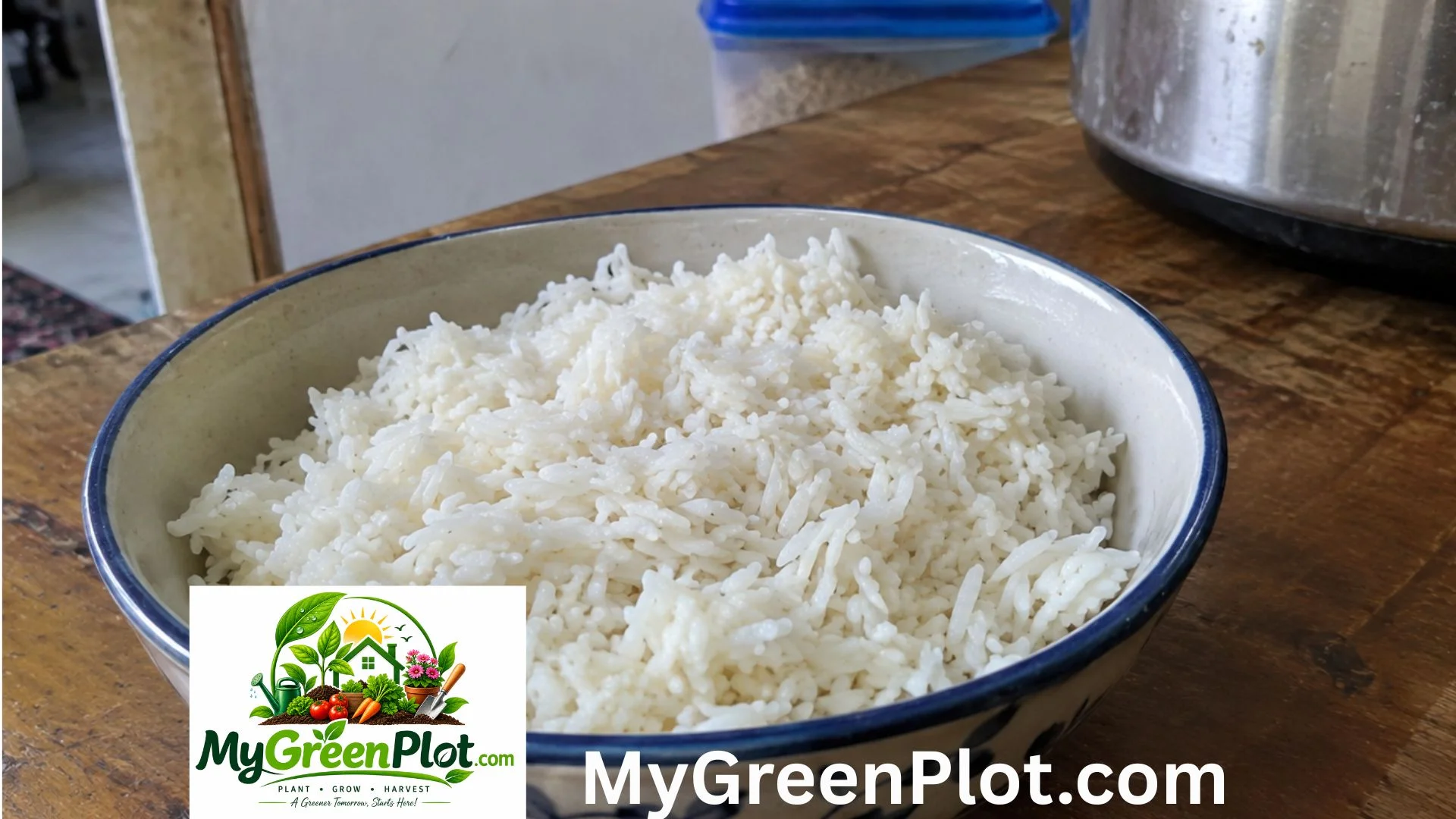
No, rice is not a vegetable; rice is a cereal grain produced by grasses in the genus Oryza. The most widely cultivated species, Oryza sativa, belongs to the Poaceae family, the same botanical family that includes wheat, barley, oats, and other grasses. USDA describes rice as a cereal crop, while the Royal Botanic Gardens, Kew identifies Oryza sativa as a grass that can grow more than 1 meter tall.
The confusion comes from the fact that rice is a plant and the part people eat is technically part of a plant’s reproductive structure. But being plant-based does not make a food a vegetable.
A rice grain is produced on a flowering grass, harvested as a grain, and processed into foods such as white rice and brown rice. Botanically, the grain is a caryopsis, a specialized type of dry fruit found in grasses.
Is rice a vegetable or a grain?
Rice is a grain rather than a vegetable because the edible rice kernel develops as the grain of a grass species rather than as a leafy, root, stem, or other vegetable structure.
The cultivated rice species Oryza sativa belongs to the Poaceae family, and USDA’s Economic Research Service classifies rice as a major cereal crop.
Vegetables are commonly understood in food and agriculture as edible plant parts such as roots, stems, leaves, and immature or mature plant structures used as vegetables. Carrots provide an obvious root example, lettuce provides a leaf example, and celery provides a stem example.
Rice is different.
The rice plant produces a panicle, which is a branched flowering structure containing many spikelets. At maturity, those spikelets contain the rice grains that farmers harvest.
The U.S. Geological Survey describes Oryza sativa as a semiaquatic annual grass, with mature panicles containing numerous spikelets.
That structure places rice firmly among cereal grains.
What type of plant is rice?
Rice is a grass, and cultivated Asian rice is scientifically known as Oryza sativa.
The Royal Botanic Gardens, Kew lists Oryza sativa within the family Poaceae, the grass family, and describes the plant as an annual or wetland-adapted grass.
A mature rice plant can reach roughly 90–150 centimeters in height under typical descriptions, although plant size varies by cultivar and growing conditions. Kew describes Asian rice as a grass capable of growing to more than 1 meter tall.
The plant has upright stems, long narrow leaves, and a flowering panicle near the top.
Those features are useful when trying to understand why rice belongs with cereal crops rather than vegetables.
The same family contains many familiar grain-producing plants. Wheat, barley, oats, and rye are all grasses, although they belong to different genera.
Rice therefore is not an unusual exception among food crops. It is one of the world’s major grain-producing grasses.
Is rice technically a seed or a fruit?
A rice grain contains a seed, but botanically the whole grain is a caryopsis, a type of dry fruit characteristic of grasses.
This is where rice classification gets more interesting.
The USDA National Agricultural Library defines a caryopsis as the fruit of a grass in which the seed and fruit wall are closely united.
That means the ordinary word “grain” and the botanical word “fruit” can describe different aspects of the same structure.
When you look at a rice kernel, you are not looking at a berry or a fleshy fruit such as a peach. You are looking at the mature reproductive structure of a grass.
USDA Agricultural Research Service describes paddy rice as a spikelet containing a caryopsis surrounded by a hull. The caryopsis includes the seed and its closely attached outer layers.
So there are three useful terms to keep separate:
- Rice plant: the grass Oryza sativa
- Rice grain: the harvested cereal grain
- Caryopsis: the botanical fruit type containing the rice seed
That distinction explains why saying “rice is a seed” is incomplete, while saying “rice is a fruit” without qualification can also be misleading.
Why is rice called a cereal grain?
Rice is called a cereal grain because it is the edible grain of a grass cultivated primarily for its carbohydrate-rich seed-producing structure.
USDA identifies rice as a cereal crop and notes that it is a primary staple food for more than half of the world’s population.
The word cereal comes from the group of grasses cultivated for their edible grains.
Rice fits this definition alongside crops such as wheat and oats.
The difference is that rice is adapted to growing conditions that can include flooded or water-managed fields. USDA notes that economically viable rice production generally requires high daytime temperatures, cooler nights, and substantial water availability during the growing season.
That growing environment does not make rice a vegetable.
It simply describes how one particular cereal grass is cultivated.
What part of the rice plant do people eat?
People primarily eat the rice grain, which develops inside a protective hull on the mature rice plant.
USDA Agricultural Research Service describes each rice spikelet as containing a caryopsis surrounded by a hull made from specialized structures called the lemma and palea.
After harvesting, the inedible outer hull is removed during processing.
The remaining grain can then be processed further depending on the type of rice being produced.
This is why the rice sitting in your kitchen looks very different from the rice plant standing in a field.
A field contains tall grass-like plants with green leaves and panicles. A bag of white rice contains processed kernels in which several outer layers have been removed.
The food has changed physically, but its botanical identity has not changed.
Is brown rice a vegetable?
Brown rice is not a vegetable because it is still a rice grain with its outer hull removed while much of the bran and germ remain.
The USDA Agricultural Marketing Service defines brown rice as kernels with the hull removed.
That distinction matters because brown rice and white rice are not two different vegetable species.
They are different forms of processed rice.
Brown rice retains more of the grain’s outer layers than polished white rice. White rice is milled further, removing the bran and germ and leaving primarily the starchy endosperm.
USDA’s description of rice anatomy identifies the caryopsis as containing structures including the embryo and endosperm.
So changing brown rice into white rice changes the physical composition of the grain, not its basic classification as a cereal grain.
Is cooked rice a vegetable?
Cooking rice does not turn it into a vegetable because heating changes its physical properties rather than changing the biological identity of the grain.
When rice is cooked in water, the starch absorbs water and the grains become softer.
A dry grain can therefore become a bowl of fluffy cooked rice without becoming a different category of food.
The same principle applies to other grains.
Cooked oatmeal is still made from oats, and cooked wheat berries are still wheat grains.
Rice can also be incorporated into dishes containing vegetables, but the presence of vegetables in a meal does not change the classification of the rice itself.
For example, fried rice containing peas, carrots, and onions contains vegetables, but the rice component remains a cereal grain.
Is wild rice actually rice?
Wild rice is not the same species as Asian cultivated rice because traditional wild rice belongs to the genus Zizania rather than Oryza.
This is an easy source of confusion.
The common cultivated rice eaten around the world is primarily associated with Oryza sativa. Kew describes Oryza sativa as Asian rice and identifies major cultivar groups including Indica and Japonica.
Wild rice traditionally harvested in North America comes from a different grass, ** Zizania palustris **.
Kew specifically distinguishes wild rice from Oryza sativa, noting that wild rice is produced by Zizania palustris, a separate species of grass.
Despite that difference, wild rice is still not a vegetable.
It is the grain of another grass.
The name “wild rice” describes its food use and appearance rather than placing it inside the botanical genus Oryza.
Is rice closer to wheat or vegetables?
Rice is botanically much closer to wheat than to vegetables such as carrots because both rice and wheat belong to the grass family Poaceae.
Rice belongs to the genus Oryza, while wheat belongs primarily to the genus Triticum.
They are different genera, but both are grasses.
That relationship is more meaningful botanically than the fact that rice and carrots are both eaten as plant foods.
A carrot belongs to a flowering-plant family completely different from Poaceae.
Rice and wheat also share the cereal-grain characteristic of producing caryopses. USDA explains that grains produced by cereal grasses represent caryopses, in which the fruit and seed are closely associated.
So if you are looking for rice’s closest familiar food category, cereal grain is much more accurate than vegetable.
Why do people sometimes think rice is a vegetable?
Rice is sometimes mistaken for a vegetable because everyday food categories do not always follow botanical classification.
A grocery store groups foods according to how people buy, cook, and eat them.
Botany uses a different system based on plant structure and evolutionary relationships.
For example, a tomato is botanically a fruit even though it is commonly prepared and sold as a vegetable. Rice creates the opposite kind of confusion: it comes from a plant, but the edible part is a grain produced by a grass.
The distinction becomes easier when you ask what part of the plant you are eating.
A lettuce leaf is a vegetable.
A carrot root is a vegetable.
A rice grain is a cereal grain.
A mature rice plant can grow to more than 1 meter and produces its grains on a branched panicle rather than producing an edible root, leaf, or stem.
What food group does rice belong to?
Rice belongs to the grain or cereal group rather than the vegetable group.
Nutrition and food-group systems can organize foods differently from botanical taxonomy, but rice consistently fits within the grain category.
USDA’s Economic Research Service describes rice as a major cereal crop and one of the world’s most important staple foods.
The common forms include white rice, brown rice, parboiled rice, and specialty varieties such as long-grain and short-grain rice.
USDA’s Agricultural Marketing Service recognizes rice classes including long grain, medium grain, short grain, and mixed.
Those categories describe grain characteristics and processing, not vegetable types.
So when planning a meal, rice generally fills the grain or starch role rather than the vegetable portion.
Does rice grow like a vegetable?
Rice grows as a grass with narrow leaves and grain-bearing panicles rather than as a vegetable crop producing edible roots, bulbs, or leafy heads.
The mature Oryza sativa plant develops a jointed stem, long leaves, and a terminal panicle containing many spikelets. USGS describes rice as a semiaquatic annual grass with a terminal panicle that can contain 50–500 spikelets.
That structure is very different from a carrot plant, where the swollen root is the primary harvested food.
It is also different from cabbage, where the compact leafy head is harvested.
Rice farmers are essentially cultivating a grass for its mature grains.
The field may be flooded or irrigated, which makes a rice paddy visually different from a wheat field, but the harvested product remains a cereal grain.
Is rice a vegetable, fruit, seed, or grain?
Rice is best described as a cereal grain in everyday agricultural language and as a caryopsis containing a seed in botanical terminology.
Calling rice a vegetable is incorrect.
Calling it simply a seed is incomplete because the rice grain is a caryopsis, meaning the fruit wall and seed are closely associated.
Calling it a fruit is botanically defensible only when referring to the caryopsis as a fruit type, but that wording can confuse readers because rice is not a fleshy fruit like an apple.
The clearest answer is therefore:
Rice is a cereal grain produced by a grass.
The principal cultivated species, Oryza sativa, belongs to Poaceae, grows as a grass, and produces grains that develop within spikelets.
That classification remains true whether the grain is sold as brown rice, milled into white rice, or cooked into a bowl of rice.

1 Comment
Pingback: Is Eggplant a Fruit? The Botanical Answer Explained - mygreenplot.com