

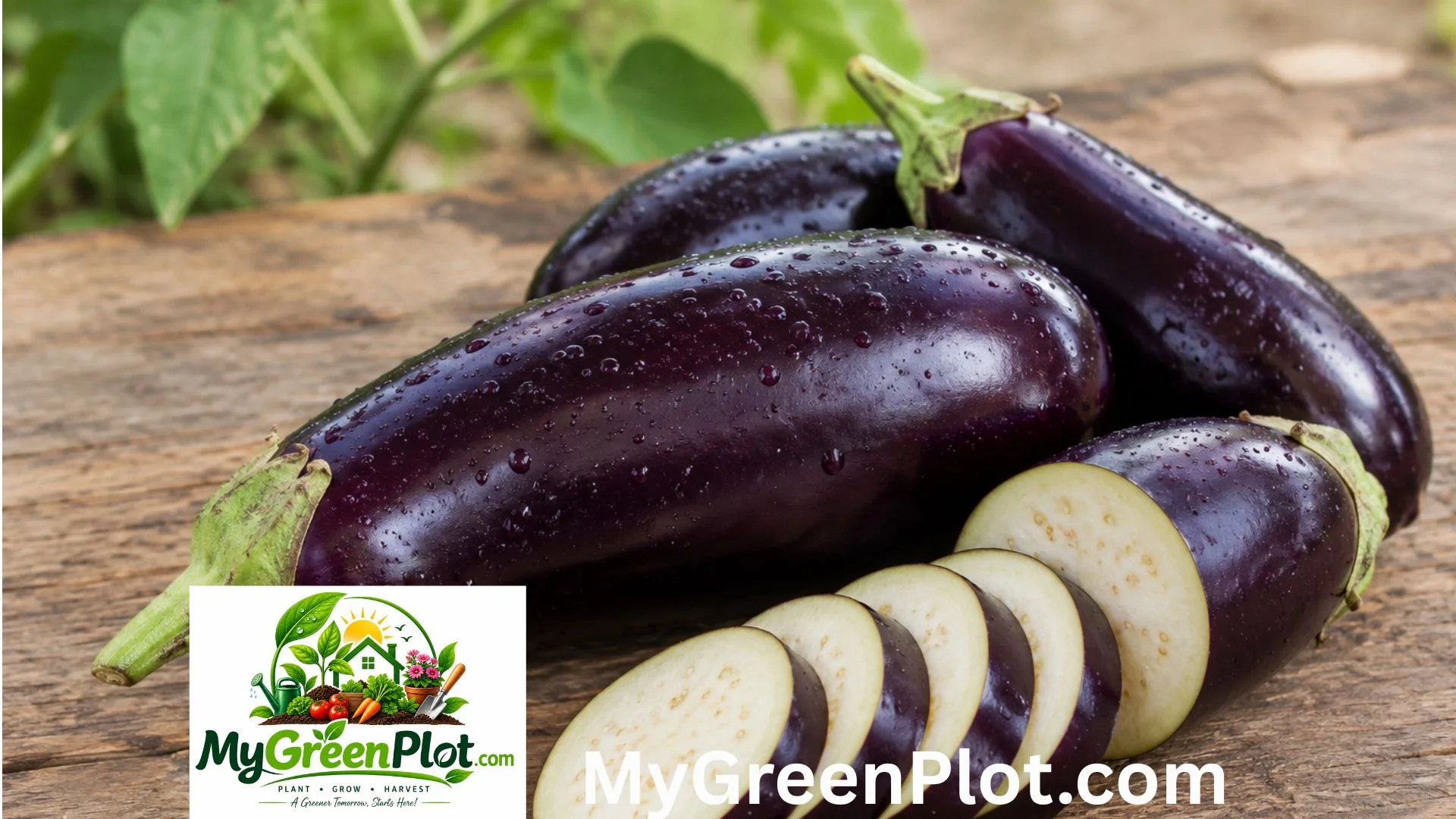
Yes, eggplant is a fruit botanically, even though it is commonly treated as a vegetable in cooking and commercial agriculture. The edible part of Solanum melongena develops from the plant’s flower and contains numerous seeds, which places it in the botanical fruit category. North Carolina State University classifies the eggplant fruit specifically as a berry, with common fruits measuring about 4–8 inches long.
That does not mean calling eggplant a vegetable is wrong. The two terms come from different classification systems.
Why is eggplant botanically a fruit?
Eggplant is a botanical fruit because its edible structure develops from the flower and contains seeds.
The cultivated eggplant, Solanum melongena, belongs to the Solanaceae family, the same plant family as tomatoes, peppers, and potatoes. USDA describes eggplant as a warm-season plant that produces violet, star-shaped flowers before developing its edible fruit.
This flower-to-fruit development is the key point.
Botanically, a fruit is a mature structure that develops from the reproductive parts of a flowering plant, most commonly the ovary, and encloses or carries seeds. Eggplant fits that description because the purple or white structure you harvest develops after flowering and contains seeds within its flesh.
If you grow eggplant, you can actually watch the process. A flower appears first, and a small swelling develops behind the flower as the fruit begins forming.
The edible eggplant is therefore not a root, leaf, or stem.
It is the plant’s fruit.
Why is eggplant called a vegetable?
Eggplant is called a vegetable because culinary and commercial classifications are based on how the crop is used rather than strictly on botanical fruit structure.
The U.S. Department of Agriculture’s Agricultural Marketing Service maintains specific eggplant grades and standards, including quality categories based on characteristics such as firmness, color, shape, cleanliness, and freedom from decay.
In the kitchen, eggplant is normally prepared as a savory food.
You roast it, grill it, fry it, stuff it, add it to curries, or cook it in dishes such as eggplant Parmesan. USDA’s plant guide lists baking, sautéing, stuffing, frying, stewing, soups, and curries among common uses for eggplant fruit.
That practical use is why grocery stores and cooks generally place eggplant in the vegetable category.
So there is no real disagreement between a botanist and a chef.
The botanist is describing what the plant produces.
The chef is describing how the food is used.
What kind of fruit is an eggplant?
An eggplant is botanically classified as a berry because it is a fleshy, seed-containing fruit that develops from a flower.
The word “berry” causes confusion because everyday language usually associates berries with small, sweet fruits.
Botanical terminology works differently.
North Carolina State University’s Plant Toolbox identifies Solanum melongena as producing a berry and describes the fruit as smooth, glossy, and containing numerous small seeds.
The fruit can be egg-shaped, oval, round, or elongated.
Some common fruits measure approximately 4–8 inches long, while other cultivars are much smaller or have unusually long, narrow shapes.
So the size of an eggplant does not prevent it from being a berry.
Botanical classification depends on structure, not whether the fruit looks like a blueberry.
How does an eggplant develop from a flower?
An eggplant begins as a violet, star-shaped flower before the flower’s reproductive structures develop into the fleshy fruit.
USDA’s Natural Resources Conservation Service describes eggplant flowers as violet and star-shaped, with flowers appearing individually or in clusters. The plant commonly reaches about 2–4 feet tall.
The fruit forms after the flower’s ovary begins enlarging.
That connection between flower and mature fruit is one of the clearest ways to understand the classification.
You can see the transition in a garden: first there is a flower, then a tiny developing fruit, followed by the increasingly large eggplant that eventually becomes suitable for harvest.
The process is similar in principle to tomatoes and peppers, which also produce botanical fruits from flowers.
Do eggplants contain seeds?
Eggplant fruits contain numerous small seeds embedded inside their fleshy interior.
A mature eggplant can look almost seedless from the outside, but cutting it open reveals many small, pale seeds distributed through the flesh.
North Carolina State University describes the seeds as small, flat, and ranging from pale yellow to brown.
Seed development is important because the seeds are part of the reproductive function of the fruit.
The texture of those seeds can also change as the eggplant matures.
A younger, properly harvested fruit generally has smaller and softer seeds, while an overmature eggplant can become more fibrous and develop tougher seeds. North Carolina State University notes that mature fruits can become stringy and bitter.
That is one reason gardeners usually harvest eggplant before allowing the fruit to become fully mature on the plant.
Are all eggplants purple?
Eggplant fruits occur in several colors and shapes, so the familiar dark-purple grocery-store eggplant represents only one group of cultivars.
USDA research on Solanum melongena documents substantial variation in fruit characteristics, including green, white, light-purple, and dark-purple fruits. A current USDA research project describes fruit diameters ranging from approximately 3 to 12 centimeters and length-to-width ratios ranging from less than 1 to greater than 5.
Other extension information lists eggplant fruit colors including black, gold-yellow, green, purple-lavender, and white.
Shape varies just as much.
Some cultivars are short and round, some resemble eggs, and Japanese or Oriental types can be long and slender. University of Missouri Extension describes eggplant fruit shapes ranging from round and bell-shaped to oval and elongated.
The color or shape does not change the botanical classification.
A white eggplant is still a fruit.
A striped eggplant is still a fruit.
A long Japanese eggplant is still a fruit.
Is eggplant related to tomatoes and peppers?
Eggplant is closely related to tomatoes and peppers because all three belong to the Solanaceae, or nightshade, family.
The scientific name Solanum melongena places eggplant in the genus Solanum. Tomatoes and peppers belong to the same broader family but different genera, while potato is another close nightshade relative. USDA and University of Missouri Extension both identify eggplant as a member of the Solanaceae family.
This relationship helps explain why several of these crops share similar botanical characteristics.
Tomatoes produce fleshy fruits containing seeds.
Peppers produce fruits containing seeds.
Eggplants do the same.
Potatoes are different because the part people normally eat is an underground tuber rather than the fruit.
That distinction matters when talking about whether a plant is a fruit or vegetable: the plant family does not automatically determine which part of the plant you eat.
Is eggplant a fruit like a tomato?
Eggplant and tomato are both botanical fruits, and both are classified botanically as berries.
The comparison with tomato is useful because most people already recognize tomatoes as a common example of a food that is botanically a fruit but culinarily treated as a vegetable.
Eggplant follows the same basic pattern.
Both produce fleshy fruits containing seeds, and both belong to the nightshade family.
Their physical appearance and culinary uses are different, but those differences do not change their botanical classification.
The USDA’s plant information for eggplant identifies Solanum melongena as the cultivated species, while extension sources classify its fruit as a berry.
Why does the fruit-versus-vegetable argument cause so much confusion?
The confusion exists because “fruit” and “vegetable” can describe different properties of the same food.
Botany asks a structural question: What part of the plant is this, and how did it develop?
Cooking asks a practical question: How is this food normally prepared and eaten?
For eggplant, those questions produce different answers.
Botanically, the answer is fruit.
Culinarily, the answer is vegetable.
Commercially, eggplant is also handled within vegetable-market systems, as shown by the USDA Agricultural Marketing Service’s dedicated eggplant grading standards.
None of these classifications cancels out the others.
They simply describe different aspects of the same crop.
How big can eggplant fruit become?
Common eggplant fruits are often about 4–8 inches long, but cultivar differences can produce much smaller, larger, rounder, or longer fruits.
North Carolina State University gives a typical fruit length of 4–8 inches for Solanum melongena.
USDA’s current germplasm research shows how broad the variation can be, recording fruit diameters from approximately 3 to 12 cm across different types.
That variation is useful for gardeners choosing cultivars.
If you want compact fruits for grilling or individual portions, a smaller cultivar may be more practical. If you want the familiar large supermarket type, choose a cultivar bred for larger fruit.
The botanical definition remains unchanged regardless of the cultivar’s final dimensions.
So, is eggplant a fruit or a vegetable?
Eggplant is both a botanical fruit and a culinary vegetable, with “fruit” being the scientifically precise description of the edible structure.
The plant is Solanum melongena, a member of the Solanaceae family. Its edible portion develops from the flower, contains seeds, and is botanically classified as a berry.
At the same time, calling eggplant a vegetable is completely normal when discussing cooking, grocery shopping, or commercial produce.
So if someone asks, “Is eggplant a fruit?”, the accurate botanical answer is yes.
If someone asks where to find eggplant in a supermarket or how to use it in a savory recipe, calling it a vegetable is equally practical.
Sources: USDA Agricultural Marketing Service — Eggplant Grades and Standards | USDA Natural Resources Conservation Service — Eggplant Plant Guide | North Carolina State University Extension — Eggplant | USDA Agricultural Research Service — Eggplant Research
Read More : Is Rice A Vegetable?
