

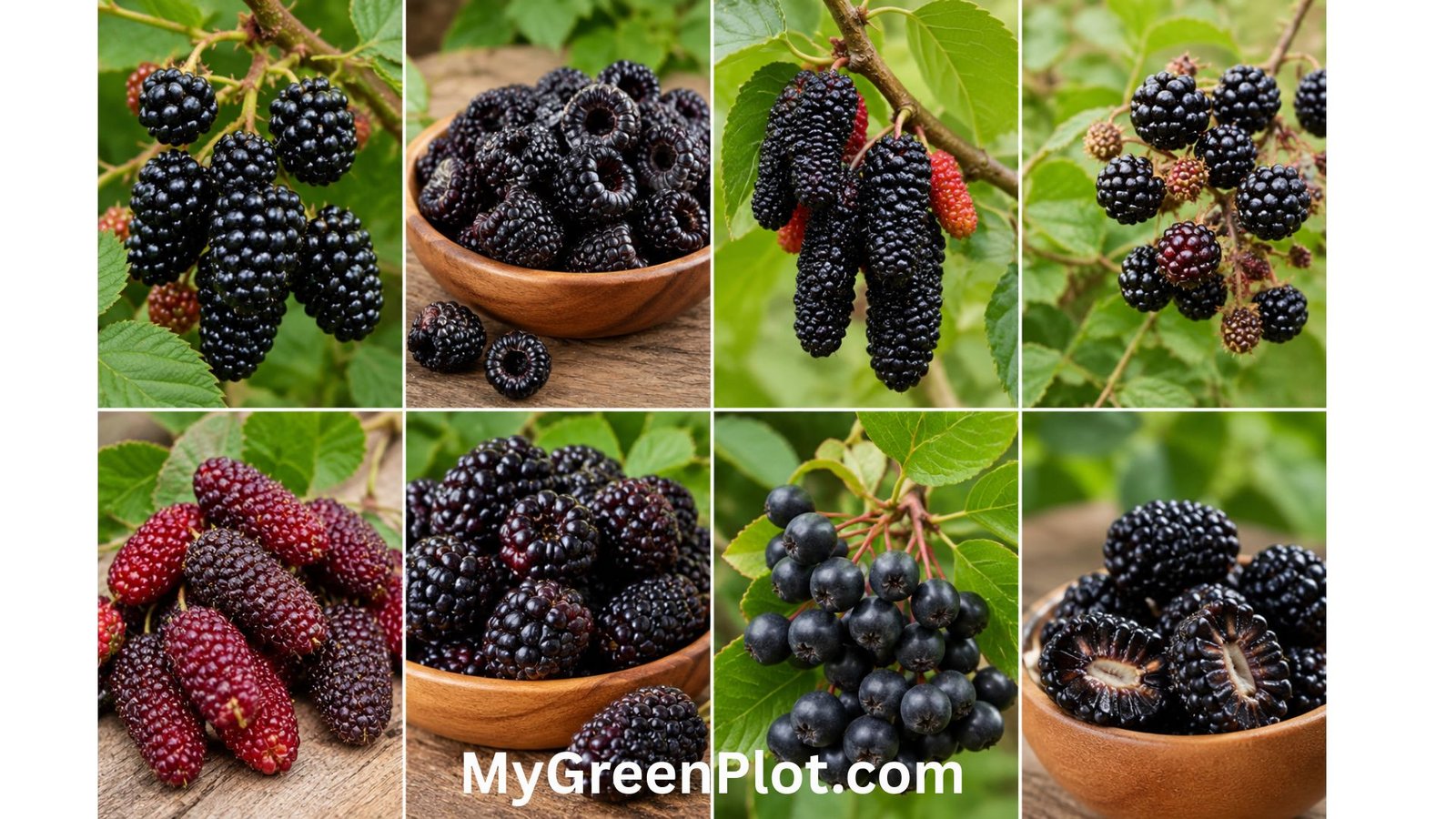
Blackberries are loved for their deep purple-black color, juicy texture, and sweet-tart flavor. However, several other fruits can look remarkably similar to them. Some grow in clusters, some have a glossy dark surface, and others are easily confused with blackberries because of their size and color.
This guide explores fruits that look like blackberries, explains how to tell them apart, and highlights their flavor, appearance, growing habits, and common uses.
Mulberries: One of the Closest Blackberry Look-Alikes
Mulberries are among the most recognizable fruits that resemble blackberries. They are usually long and cylindrical rather than round, with many tiny sections packed together.
Black mulberries can become very dark when fully ripe, making them particularly easy to confuse with blackberries. They tend to have a soft texture and a sweet flavor, sometimes with a pleasant tartness.
One useful way to distinguish them is by shape. Blackberries are generally more rounded, while mulberries are often elongated. Mulberries also grow on trees, whereas blackberries grow on trailing or upright canes.
Black Raspberries: Similar in Color and Shape
Black raspberries can look almost identical to blackberries at first glance. Both are small, dark-colored fruits made up of many individual drupelets.
The easiest way to tell them apart is by the fruit’s center. When a ripe black raspberry is picked, it usually separates from its core, leaving a hollow center. A blackberry generally retains its central core when harvested.
Black raspberries are also known for their rich, sweet flavor and are commonly eaten fresh or used in jams, pies, sauces, and desserts.
Dewberries: A Wild Blackberry Relative
Dewberries are closely related to blackberries and can be difficult to distinguish from them. They typically grow on low, trailing plants and produce dark purple to black fruits.
Like blackberries, dewberries consist of numerous small drupelets. Their fruits can be somewhat softer and more delicate than many cultivated blackberries.
Because dewberries often grow wild, they are commonly encountered along fields, woodland edges, roadsides, and other natural areas. However, wild berries should only be eaten when their identity is certain.
Loganberries: A Reddish-Black Blackberry Relative
Loganberries are a hybrid of blackberry and raspberry. Their elongated shape and deep red-to-purple color can make them look similar to certain blackberry varieties.
Unlike fully black blackberries, ripe loganberries often retain reddish or wine-colored tones. They generally have a distinctive sweet-tart flavor and are particularly popular for making preserves, pies, syrups, and other desserts.
Their hybrid characteristics make them especially interesting for gardeners and fruit enthusiasts who want something different from traditional berries.
Also Read : Fruits That Look Like Apricots
Boysenberries: Large, Dark, and Juicy
Boysenberries are another hybrid fruit that can easily be mistaken for blackberries. They are usually larger than ordinary blackberries and have a dark reddish-purple to nearly black appearance when ripe.
Their flavor combines sweet and tart notes, often with a juicy texture. Boysenberries are excellent for eating fresh and are also used in pies, jams, sauces, smoothies, and baked goods.
Their size can provide a clue: if a berry looks like an unusually large, elongated blackberry, it may be a boysenberry.
Also Read : Fruits That Look Like Grapes
Black Chokeberries: A Different Fruit With a Similar Color
Black chokeberries, also called aronia berries, are another fruit that may catch your attention because of their nearly black appearance. However, they are quite different from blackberries.
Chokeberries grow in clusters on shrubs and tend to be smaller and rounder than blackberries. They also have a notably astringent flavor, especially when eaten raw.
Their dark color makes them attractive in gardens and food products, but their taste is much more intense than that of a typical sweet blackberry.
How to Tell Blackberries Apart From Similar Fruits
Identifying a dark berry is easier when you consider more than color. Several characteristics can help you determine what you are looking at.
| Fruit | Typical Appearance | Where It Grows | Key Difference |
| Blackberry | Round, dark purple-black | Thorny or thornless canes | Usually retains its core |
| Black raspberry | Dark, rounded, hollow inside | Canes | Comes off the core when picked |
| Mulberry | Long and dark | Trees | Elongated shape and tree growth |
| Dewberry | Dark, clustered fruit | Low trailing canes | Often grows close to the ground |
| Loganberry | Long, red-purple | Canes | More reddish and elongated |
| Boysenberry | Large, dark red-purple | Canes | Usually larger and softer |
| Black chokeberry | Small, round, dark | Shrubs | Astringent taste and clustered growth |
When identifying wild fruits, consider the plant, leaves, stems, fruit structure, and growing location, rather than relying on color alone.
Uses, Nutrition, and Safe Identification
Many of these blackberry look-alikes can be enjoyed fresh or incorporated into foods such as smoothies, jams, pies, sauces, and baked desserts. Berries with deep purple or black coloring also commonly contain naturally occurring plant compounds such as anthocyanins.
However, appearance alone is not a reliable method for identifying a wild fruit. Some edible berries closely resemble fruits that should not be eaten. If you are unfamiliar with a wild plant, use a reliable field guide or consult an experienced local expert before consuming it.
For home gardeners, another useful distinction is how the plant grows. Trees, shrubs, upright canes, and trailing vines can quickly narrow down the possibilities. Looking at the entire plant is fruits most easily confused with blackberries because they share a similar dark color and clustered structure. Their hollow center usually much more reliable than looking at the berry alone.
FAQs About Fruits That Look Like Blackberries
1. What fruit looks most like a blackberry?
Black raspberries are among the fruits most easily confused with blackberries because they share a similar dark color and clustered structure. Their hollow center when picked is one of the best ways to distinguish them.
2. Are mulberries and blackberries the same fruit?
No. Mulberries and blackberries are different fruits and loganberries, boysenberries, and black chokeberries. Although their dark colors and clustered structures can make them look alike, differences in shape, plant grow on different types of plants. Mulberries grow on trees, while blackberries grow on canes.
3. What is the difference between blackberries and raspberries?
A ripe black raspberry usually separates from its core when picked, leaving a hollow center. A blackberry generally remains attached to its central core.
4. Are all black fruits that look like blackberries edible?
No. You should never assume that a dark berry is edible simply because it resembles a blackberry. Correct identification is important, particularly when collecting wild fruits.
5. Which blackberry-like fruits are hybrids?
Several popular fruits are hybrids involving blackberries and raspberries. Loganberries and boysenberries are well-known examples and are valued for their distinctive flavors and larger fruit.
Conclusion
There are several fruits that look like blackberries, including black raspberries, mulberries, dewberries, loganberries, boysenberries, and black chokeberries. Although their dark colors and clustered structures can make them look alike, differences in shape, plant type, fruit structure, and flavor can help distinguish them.
The most important point is to look at the whole plant rather than the fruit alone, especially when dealing with wild berries. With careful observation, it becomes much easier to recognize which dark-colored fruit you have found and understand how it differs from a true blackberry.
