

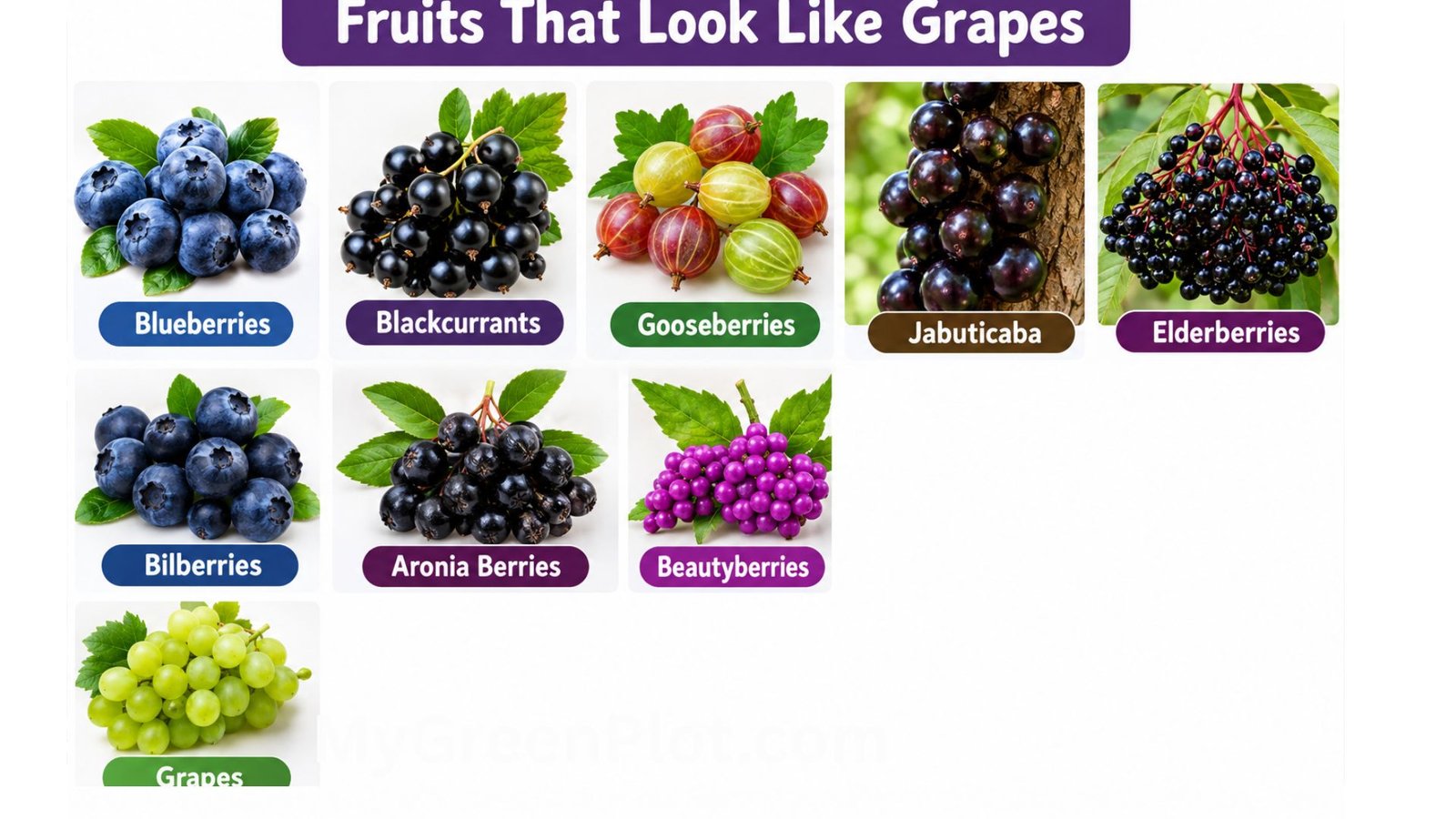
Many fruits have a round or oval shape, smooth skin, and grow in clusters, making them resemble grapes. Some are closely related to grapes, while others only look similar but belong to completely different plant families. This guide explores fruits that look like grapes, including their appearance, flavor, common uses, and key differences.
What Are Fruits That Look Like Grapes?
Fruits that look like grapes are fruits that share one or more visual characteristics with grapes. They may have a small, round shape, grow in clusters, or have smooth, colorful skin.
However, appearance alone does not mean that a fruit is related to grapes. For example, some grape-like fruits are tropical fruits, berries, or members of entirely different botanical families.
Their flavors can also vary considerably, ranging from sweet and juicy to tart and refreshing.
Blueberries
Blueberries are among the most familiar fruits that can resemble grapes because of their small, round shape and blue-purple color.
Unlike grapes, blueberries usually grow individually on bushes rather than in large hanging clusters. They have a firm outer skin and juicy interior.
Flavor: Sweet, mildly tart, and fruity
Common uses: Smoothies, cereals, desserts, salads, and snacks
Blueberries are generally smaller than most table grapes and have a distinctive flavor that makes them easy to distinguish once tasted.
Blackcurrants
Blackcurrants are small, dark-colored fruits that can look somewhat like tiny black grapes. They typically grow in clusters and have a glossy appearance.
Their flavor is quite different from that of sweet grapes. Blackcurrants are usually strongly tart and aromatic, which makes them popular for juices, jams, syrups, and desserts.
Flavor: Tart, rich, and slightly sweet
Common uses: Jams, beverages, sauces, desserts, and preserves
Their dark color and clustered growth make them one of the more noticeable grape-like fruits.
Gooseberries
Gooseberries are another fruit that may be included among fruits that look like grapes, particularly because some varieties are round or oval and have translucent green, yellow, red, or purple skin.
Some gooseberries have visible veins or stripes on their skin, which helps distinguish them from ordinary grapes. Their flavor can range from quite sour when unripe to sweet and fruity when fully ripe.
Flavor: Tart to sweet
Common uses: Pies, jams, sauces, desserts, and fresh eating
Gooseberries are usually larger and have a different texture from grapes.
Jabuticaba
Jabuticaba is a fascinating tropical fruit because it can look remarkably similar to dark grapes. The fruit is round, usually dark purple to nearly black, and has a juicy interior.
One unusual feature is where it grows. Instead of hanging from the tips of branches like grapes, jabuticaba fruits grow directly on the trunk and larger branches of the tree.
Flavor: Sweet and slightly acidic
Common uses: Fresh eating, juices, jellies, wines, and other beverages
Its unusual growth pattern makes jabuticaba especially interesting among grape-like fruits.
Elderberries
Elderberries are small, dark purple or nearly black fruits that grow in clusters. Their appearance can therefore remind people of very small grapes.
However, raw elderberries are not generally eaten like table grapes. Proper preparation is important, and cooked or processed elderberries are commonly used in syrups, jams, jellies, and beverages.
Appearance: Small, dark berries in clusters
Common uses: Cooked preparations, syrups, jams, and beverages
Because different elderberry species and preparations can have different safety considerations, they should not simply be treated as interchangeable with edible table grapes.
Other Grape-Like Fruits to Know
Several other fruits can have a grape-like appearance, although they differ in size, flavor, texture, or growing habits.
Bilberries are small dark berries related to blueberries and can resemble small grapes because of their rounded shape.
Aronia berries, also called chokeberries, are small dark fruits that grow in clusters. They are known for their strongly astringent flavor.
Beautyberries are striking purple fruits that grow in clusters. They are mainly valued for their ornamental appearance, and identification is important before consuming any wild fruit.
These examples show that many visually similar fruits are not necessarily close relatives of grapes.
How to Tell Grape-Like Fruits Apart
When identifying fruits that look like grapes, consider more than color and shape. Important characteristics include where the fruit grows, the structure of the plant, the leaves, the fruit’s skin, and its internal structure.
| Fruit | Typical Color | Growth Pattern | General Flavor |
| Grapes | Green, red, purple, black | Clusters on vines | Sweet or tart |
| Blueberries | Blue to purple | Individual fruits on bushes | Sweet and mildly tart |
| Blackcurrants | Dark purple to black | Clusters on shrubs | Strongly tart |
| Gooseberries | Green, yellow, red, purple | Individual fruits on shrubs | Tart to sweet |
| Jabuticaba | Dark purple to black | Directly on tree trunk | Sweet and acidic |
| Elderberries | Purple to black | Clusters | Tart |
If you encounter an unfamiliar wild fruit, visual similarity to a grape is not enough to establish that it is safe to eat. Proper identification is essential.
Frequently Asked Questions
1. What fruits look like grapes?
Several fruits can resemble grapes, including blueberries, blackcurrants, gooseberries, jabuticaba, elderberries, bilberries, and some other small berries.
2. Is jabuticaba a type of grape?
No. Jabuticaba is not a grape. It is a different tropical fruit that happens to have a round, dark appearance similar to some grape varieties.
3. Which grape-like fruit grows on a tree trunk?
Jabuticaba is famous for producing its fruit directly on the trunk and larger branches of the tree rather than on conventional fruit clusters at the ends of branches.
4. Are all fruits that look like grapes safe to eat?
No. Appearance is not a reliable way to determine whether a wild fruit is edible. Some fruits can look similar while having very different properties, so unfamiliar fruits should be properly identified before consumption.
5. Are blueberries and grapes related?
Both are fruits, but blueberries and grapes belong to different plant families. Their similar round shape is mainly a visual resemblance rather than an indication that they are closely related.
Conclusion
There are many fruits that look like grapes, but their similarities can be limited to their shape, color, size, or clustered growth. Blueberries, blackcurrants, gooseberries, jabuticaba, and elderberries are examples of fruits that can remind people of grapes while offering distinctly different flavors and growing characteristics.
Learning how to distinguish these fruits is useful for understanding their culinary uses and avoiding confusion, especially when encountering unfamiliar plants. When identifyifng wild fruit, always rely on proper identification rather than appearance alone.
Click For More: Fruits That Look Alikes Tomato

1 Comment
Pingback: 15 Fruits That Look Like Apricots: A Complete Guide to Similar Fruits - mygreenplot.com